The urgency to upgrade Bitcoin to a more quantum-proof network has intensified.
Consider this – Solana announced that it has deployed post-quantum signatures on the testnet, indicating its readiness to be more secure. Even Ethereum has a roadmap for achieving quantum security.
Although the Bitcoin community is also actively discussing similar proposals, there is some doubt whether they can be implemented quickly enough before the quantum threat becomes a reality.
However, Michael Saylor, the pioneer of BTC corporate treasury, doesn’t share a similar urgency. In fact, he recently noted that quantum computing will “harden BTC,” not break it.
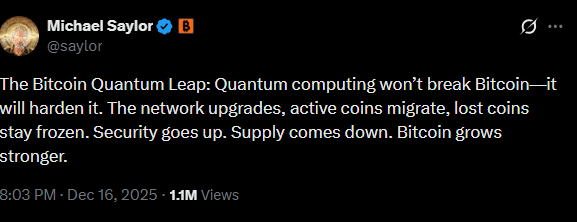
Source: X
Saylor elicits mixed reactions
For Saylor, the big tech firms will figure it out and can’t let the quantum tech go mainstream before governments update their systems. However, most experts disagree with his “simplistic” view and nonchalance.
Eli Ben-Sasson, founder of Starknet and Zcash, said that Saylor’s plans may be workable in theory, but impractical in real life due to the difficulty of reaching consensus.
“Agree, in theory. Aren’t you worried code is by now so ossified, and simple fixes (like op_cat) so hard to push that in practice it just won’t happen?”
Mihailo Bjelic, a former co-founder of Polygon, also shared similar reservations and noted,
“The upgrade takes ~2 years (~6 months if all regular txs stop, which is unrealistic). And this is assuming this major upgrade goes through smoothly, without contention (which is hard to imagine).”
Assessing the odds of quantum risk
Despite Google’s breakthrough in quantum computing, the tech is about 5-15 years or more away from becoming a real threat capable of cracking the Bitcoin network and wallets.
For his part, Charles Edwards, founder of Capriole Investments, stated that there was a 34%-55% chance that BTC could be cracked by quantum computers by 2028-2030.

Source: X
He added that Bitcoin will be devalued by similar odds if the upgrade doesn’t happen.
“Given a 2-3 yr timeline to deploy fix, this is the current discount rate. And it is growing. Every. Single. Day.”
Bitcoin’s security relies on ECDSA (Elliptic Curve Digital Signature Algorithm) and SHA-256 (hashing mechanism). The former can easily be cracked, and both public and private keys can be retrieved with a powerful quantum computer.
However, most old-format addresses (primarily from the Satoshi era) are now at risk, while new Segwit addresses are partially secure from long-range quantum attacks, according to experts.

Source: X
Final Thoughts
- Some experts are worried that Bitcoin may miss the window to upgrade to a quantum-secure network.
- The Satoshi era and a few other address formats are currently vulnerable to long-range quantum attacks.