
How Prompt Engineering is Transforming AI-Based Decision Processes in the Financial Sector
- Prompt engineering is transforming finance by enabling AI to generate unconventional insights and reduce biases through tailored queries. - Structured prompting techniques like GoT and CoT improve portfolio accuracy by 15-25%, according to 2025 studies, by forcing multi-path reasoning. - Bias-mitigation prompts force AI to avoid anchoring effects and align with institutional goals, as shown by ACM frameworks and 2025 research. - Tree-of-Thought prompts simulate expert-level scenario analysis, enabling st
The Rise of Prompt Engineering in Finance
The financial sector is experiencing a transformative shift, not solely powered by advanced algorithms, but by the strategic formulation of questions posed to artificial intelligence. Prompt engineering—the discipline of designing effective inputs for AI systems—has become an essential asset for investors aiming to extract unique insights, minimize systemic biases, and replicate the analytical processes of top-tier consultants. As generative AI tools such as Bloomberg GPT and proprietary chatbots from Morgan Stanley become integral to institutional operations, expertise in prompt engineering is quickly emerging as a key factor in generating investment outperformance.
Unlocking Unique Insights with Tailored Prompts
Financial information is notoriously intricate, filled with noise and requiring nuanced interpretation. While conventional AI models often falter in deciphering such complexity, prompt engineering bridges this gap. By customizing prompts to reflect financial jargon and metrics—like EBITDA ratios, volatility patterns, or sector rotation indicators—investors can significantly improve the accuracy of AI-driven analyses. For example, using multi-step prompts that progressively refine the query (such as, "Review Q4 earnings for technology companies, emphasizing revenue growth and R&D expenditure, then compare these figures to historical performance") enables AI to detect subtle trends that might otherwise go unnoticed, as supported by recent research.

Research conducted in 2025 by Joshi highlights the effectiveness of advanced prompting strategies like Graph-of-Thought (GoT), which can boost the accuracy of tasks such as portfolio optimization by 15-25% over traditional approaches. These structured techniques compel AI models to explore diverse reasoning paths, revealing complex relationships within data that could inform unconventional investment tactics.
Addressing Bias: Overcoming the Anchoring Effect
Although AI is often seen as objective, large language models are still susceptible to various biases. Studies indicate that even sophisticated systems like GPT-4 and Claude 2 can exhibit anchoring bias in financial predictions, where previous high or low values unduly influence current forecasts. For instance, a model might assign an inflated value to a stock simply because of its historically high price, disregarding present-day fundamentals.
Prompt engineering provides tools to counteract these tendencies. Methods such as "Chain-of-Thought" (CoT) and prompts that instruct the model to "ignore previous" data encourage step-by-step reasoning or the exclusion of irrelevant historical context. A 2025 framework from the ACM demonstrates that carefully crafted prompts—such as directing the AI to "avoid favoring large-cap or technology stocks"—can reduce confirmation bias and align AI outputs with institutional priorities. This is especially important in finance, where even minor biases can lead to significant pricing errors.
Emulating Strategic Thinking: The Consultant Advantage
Making high-stakes investment choices often requires integrating macroeconomic trends, regulatory developments, and behavioral insights—skills typically associated with elite consultants. Prompt engineering now enables AI to approximate this level of reasoning. For example, Tree-of-Thought (ToT) prompts allow AI to consider multiple scenarios (such as, "If interest rates increase by 100 basis points, how would consumer discretionary stocks perform under three different inflation scenarios?"), closely mirroring the structured analysis performed by human experts, as demonstrated by recent studies.
Organizations like Bloomberg have already adopted these advanced prompting methods in their AI platforms, allowing users to conduct detailed stress tests and scenario analyses. By embedding industry-specific prompts, investors can generate insights comparable to those offered by traditional consulting firms—without incurring substantial costs.
Practical Guidance for Investors
- Implement Structured Prompting Techniques: Utilize frameworks such as CoT, ToT, or GoT to deepen analytical reasoning. For example, when evaluating a merger, prompt the AI to "List potential synergies, regulatory challenges, and valuation gaps step-by-step."
- Adopt Bias-Detection Strategies: Use prompts like "ignore previous" or "contrast-based" to challenge AI-generated conclusions. Ask questions such as, "What critical factors might I be missing that could contradict this recommendation?"
- Partner with Leading Financial AI Providers: Collaborate with platforms like Bloomberg or Morgan Stanley to co-create prompts tailored to your organization's objectives, leveraging their expertise and integration capabilities.
Final Thoughts
Prompt engineering represents more than a technical adjustment—it marks a fundamental change in how investors engage with AI. By mastering the craft of prompt design, investors can transform AI from a passive analytical tool into an active partner, capable of delivering unconventional insights, reducing bias, and simulating sophisticated strategic thinking. As the boundaries between human and machine intelligence continue to blur, those who excel at prompt engineering will be at the forefront of the next wave of financial innovation.
Disclaimer: The content of this article solely reflects the author's opinion and does not represent the platform in any capacity. This article is not intended to serve as a reference for making investment decisions.
You may also like
Momentum ETF (MMT) and the Intersection of Retail Hype and Institutional Backing in November 2025
- Momentum ETF (MMT) surged 1,330% in Nov 2025 due to retail frenzy and institutional validation. - Binance airdrop and Sui-based perpetual futures DEX boosted retail demand through liquidity and yield incentives. - $10M HashKey funding and $600M TVL validated MMT's institutional credibility under CLARITY Act/MiCA 2.0 frameworks. - ve(3,3) governance model and token buybacks created flywheel effects, aligning retail/institutional incentives. - Q1 2026 Token Generation Lab aims to expand Sui ecosystem proje

Fed Cuts Rates, Announces $40B T-Bill Program, Crypto Dips
U.S. Marine Policy and Blue Economy Prospects: Key Infrastructure and Geostrategic Roles in Oceanic Commerce
- U.S. oceans policy balances geopolitical strategy, deep-sea tech investments, and UNCLOS ratification challenges to secure maritime influence. - Executive actions accelerate seabed mineral extraction while facing environmental criticism and legal risks from bypassing international seabed authority rules. - Offshore energy partnerships with Australia, Japan, and Saudi Arabia aim to diversify supply chains but face geopolitical tensions in chokepoints like the Red Sea. - Maritime security contracts expand

Aster DEX's On-Chain Momentum: Signaling the Future of DeFi
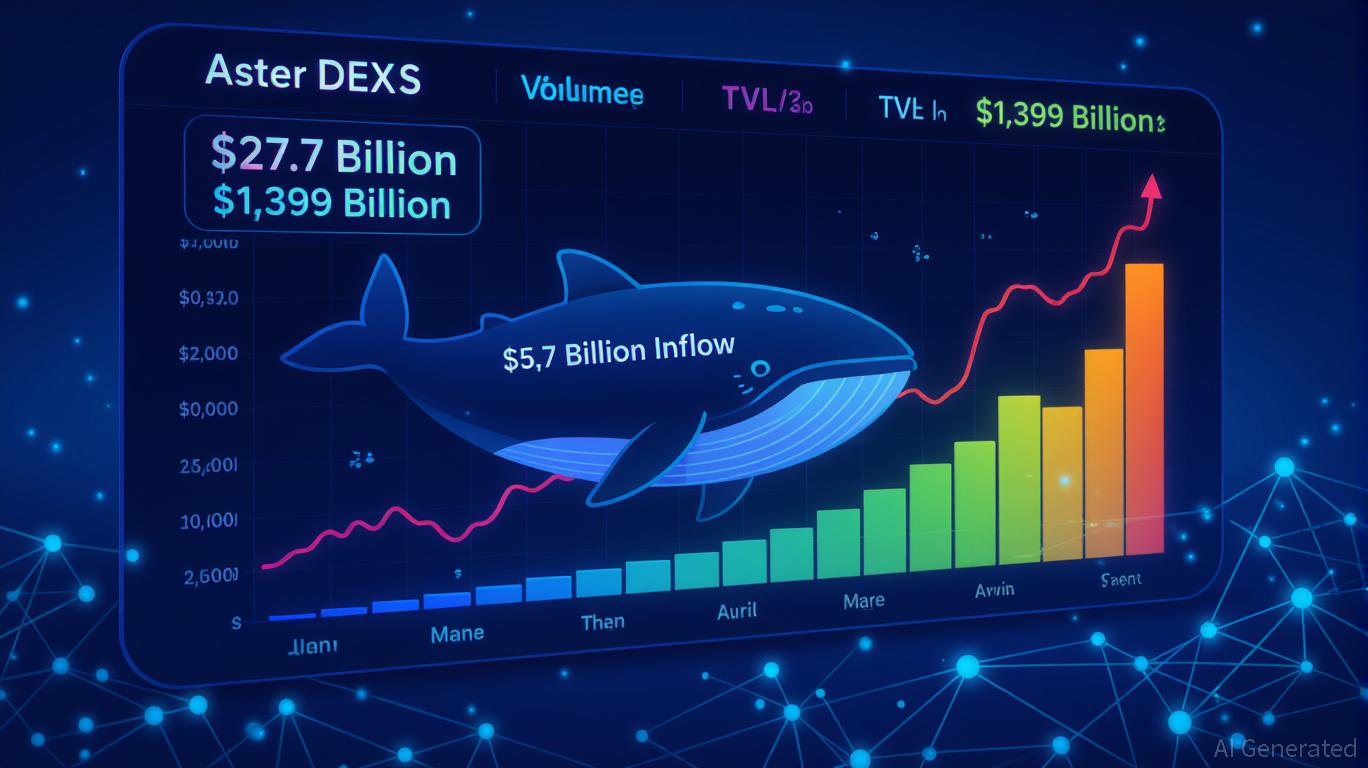
- Aster DEX reported $27.7B daily volume and $1.399B TVL in Q3 2025, outpacing DeFi benchmarks with 2M users. - Institutional whale activity, including CZ's $2M ASTER purchase, drove $5.7B inflows and 800% volume spikes. - Hybrid AMM-CEX model and ZKP privacy tech enabled 40.2% TVL growth, 77% private transactions, and 19.3% perpetual DEX market share. - ASTER's margin trading upgrades and Stage 4 airdrops fueled 30% price surges, while Aster Chain's 2026 launch will integrate privacy-preserving ZKPs. - On
Trending news
MoreCrypto prices
More





