
From ETH to SOL: Why L1 Will Ultimately Lose to Bitcoin?

It is expected that the L1 sector will continue to lose market share in the future, further squeezed by BTC.
Original Article Title: Can L1s Compete Against BTC as Cryptomoney?
Original Article Author: AvgJoesCrypto, Messari
Original Article Translation: Ding Dang, Odaily Planet Daily
Editor's Note: Recently, Dragonfly Ventures' well-known partner Haseeb Qureshi published an article rejecting cynicism and embracing exponential thinking, unexpectedly bringing the community discussion back to the most core question: the value of L1, how much is left? The following content is excerpted from @MessariCrypto's upcoming "The Crypto Theses 2026," compiled by Odaily Planet Daily.
Cryptocurrency Driving the Entire Industry
Refocusing the discussion on "cryptocurrency" itself is crucial because most of the capital in the crypto industry is ultimately seeking exposure to "monetary assets." Currently, the total market capitalization of the crypto market is $3.26 trillion, with BTC accounting for $1.80 trillion, or 55%. Out of the remaining $1.45 trillion, approximately $0.83 trillion is concentrated in various L1 blockchains. In other words, about $2.63 trillion, approximately 81% of the entire market's funds, have been invested in assets that the market already considers money or believes may receive a future money premium.
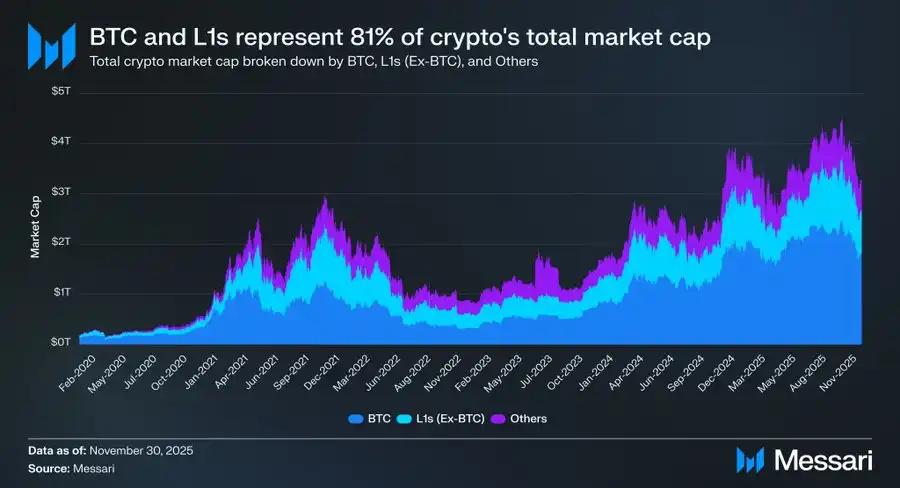
In this context, whether you are a trader, investor, fund manager, or developer, understanding how the market bestows or withdraws a money premium is crucial. In the crypto industry, nothing drives valuation changes more than whether the market is willing to view an asset as "money." Therefore, predicting which assets may receive a money premium in the future is arguably the most important variable when constructing a portfolio.
So far, our main focus has been on BTC, but it is also necessary to discuss those L1 assets in the remaining $0.83 trillion that are "potentially money or not." As mentioned earlier, we expect BTC to continue absorbing market share from gold and other non-sovereign store-of-value assets in the coming years. However, this also raises a question: How much space is left for L1? When the tide rises, will all ships (assets) float (benefit)? Or will BTC, in its pursuit of gold, also draw some money premium from L1 blockchains?
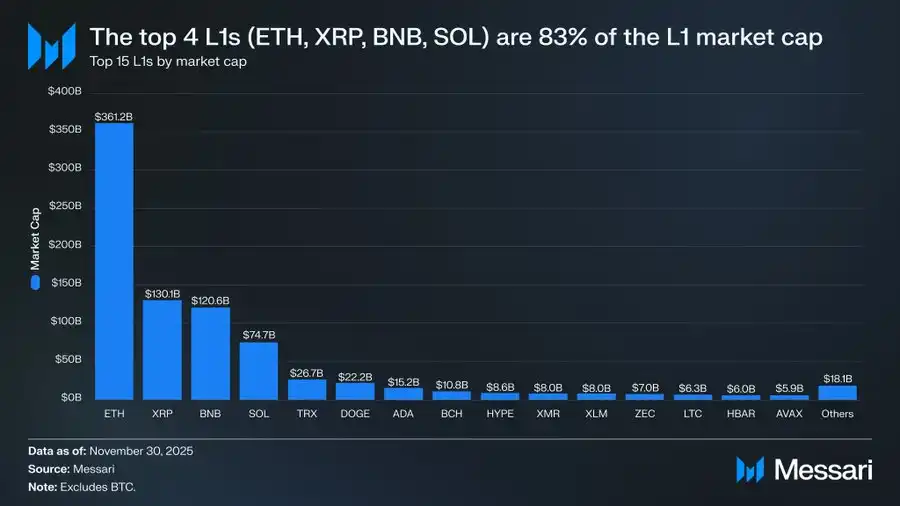
To answer these questions, we first need to look at the current valuation landscape of L1. The top four L1s by market capitalization—ETH ($3611.5 billion), XRP ($1301.1 billion), BNB ($1206.4 billion), and SOL ($746.8 billion)—have a combined market capitalization of $6865.8 billion, representing 83% of the entire L1 sector. Beyond these top four, there is a significant market capitalization gap (e.g., TRX at $266.7 billion), but the tail-end volume is still substantial. The total market capitalization of L1s outside the top 15 is still $180.6 billion, accounting for 2% of the total L1 market capitalization.
More importantly, L1's market capitalization is not equivalent to pure "monetary premium." L1's valuation framework mainly consists of three types:
(i) Monetary Premium
(ii) Real Economic Value (REV)
(iii) Economic Security Demand
Therefore, a project's market capitalization is not solely determined by the market viewing it as a currency factor.
What drives L1 valuation is the monetary premium, not revenue
Despite the existence of multiple valuation frameworks, the market is increasingly inclined to evaluate L1 from the perspective of "monetary premium" rather than "revenue-driven." Over the past few years, all L1s with a market capitalization exceeding $1 billion have maintained an overall price-to-earnings ratio of roughly 150 to 200. However, this aggregate data is misleading as it includes TRON and Hyperliquid. In the past 30 days, TRX and HYPE contributed 70% of the revenue of this group but accounted for only 4% of the total market capitalization.
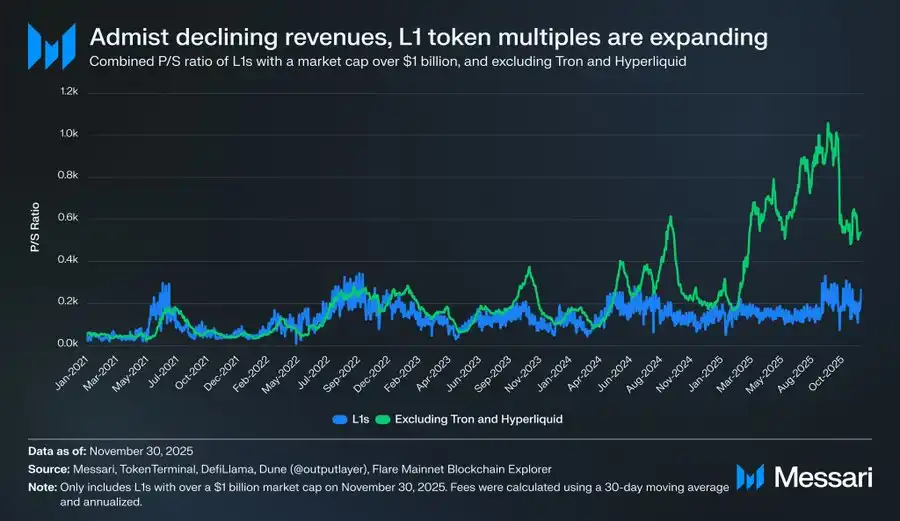
Excluding these two outliers, the true story emerges. While revenue continues to decline, L1's valuation is on the rise. The adjusted price-to-earnings ratio shows a clear upward trend:
· November 30, 2021: 40x
· November 30, 2022: 212x
· November 30, 2023: 137x
· November 30, 2024: 205x
· November 30, 2025: 536x
Interpreting this from the perspective of REV, one might think the market is pricing in future revenue growth. However, this interpretation doesn't hold because within the same group (excluding TRON and Hyperliquid), L1 revenue has been decreasing almost every year:
· 2021: $123.3 billion
· 2022: $48.9 billion (YoY -60%)
· 2023: $27.2 billion (YoY -44%)
· 2024: $35.5 billion (YoY +31%)
· 2025: Annualized $17.0 billion (YoY -52%)
In our view, the simplest and most direct explanation is: these valuations are primarily driven by currency premium rather than current or future revenue.
L1 Has Been Consistently Underperforming Bitcoin
If the valuation of L1 is primarily driven by market expectations of its currency premium, the next question is: what shapes this expectation? A simple way is to compare them with BTC's price performance. If changes in currency premium mainly reflect BTC's trend, the performance of these assets should be similar to BTC's 'β coefficient'; if the currency premium comes from each L1's unique factors, then their correlation with BTC should be weaker, and their performance should be more specific.
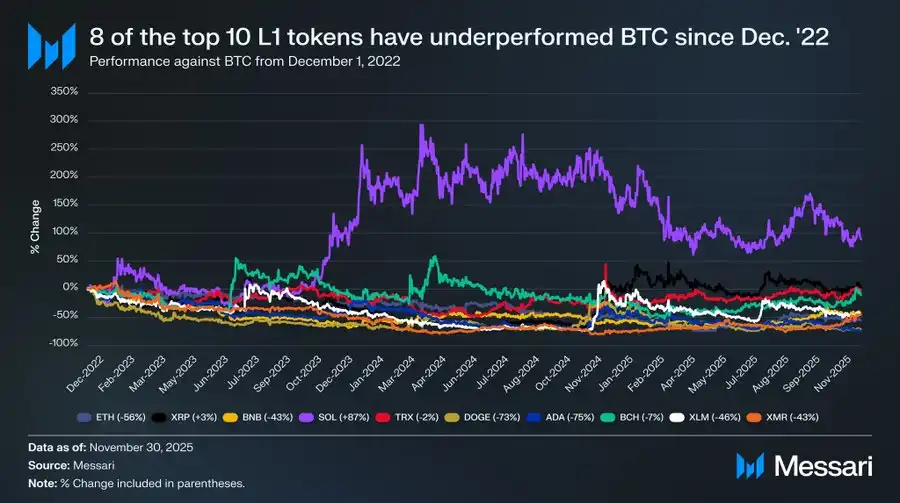
As a representative of L1, we selected the top ten market cap L1 tokens (excluding HYPE) and analyzed their performance relative to BTC since December 1, 2022. These ten assets account for approximately 94% of the L1 market cap, making them highly representative. During this period, eight assets have underperformed BTC in absolute return, with six lagging by over 40%. Only two assets outperformed BTC: XRP and SOL. However, XRP's excess return is only 3%, given its historically retail-dominated flows, which we won't read too much into. The asset that has truly significant excess returns is SOL, outperforming BTC by 87%.
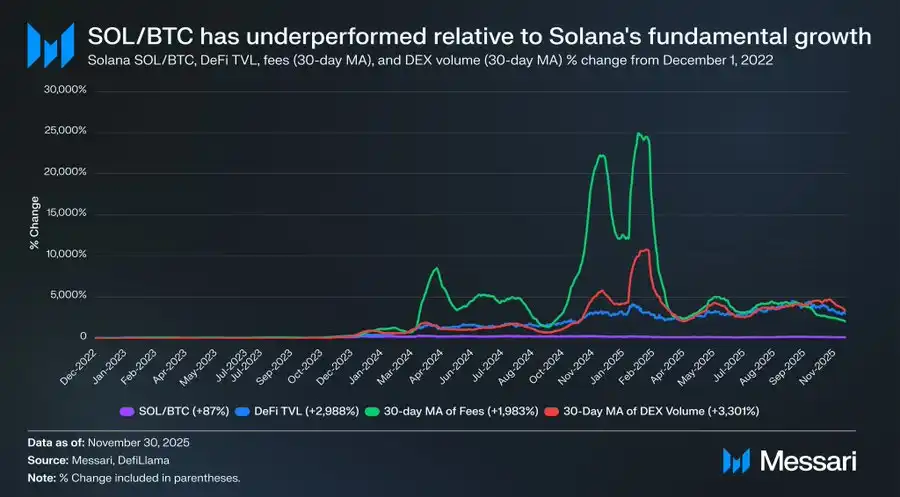
However, a deeper analysis reveals that SOL's "outperformance" may not be as strong as it seems on the surface. During the same period where SOL outperformed BTC by 87%, the fundamental aspects of the Solana ecosystem saw an exponential growth: DeFi TVL increased by 2,988%, transaction fees grew by 1,983%, and DEX trading volume surged by 3,301%. By any reasonable measure, Solana's ecosystem has expanded by 20 to 30 times since the end of 2022, yet the corresponding SOL price only outpaced BTC by 87%.
Please read that sentence again.
In order to truly achieve significant outperformance against BTC in the game, an L1 network not only needs its ecosystem to grow by 200% or 300%—it needs to grow by 2,000%-3,000% just to barely attain a few tens of percentage points of excess performance.
Considering the above, our assessment is: While the market is still pricing L1 networks based on the expectation of "future potential currency premium," confidence in these expectations is quietly waning. At the same time, the market's premium on BTC as the "cryptocurrency" has not been shaken, and it can even be said that BTC's leading advantage over various L1 networks continues to expand.
Although cryptocurrencies themselves do not need transaction fees or revenue to support their valuation, these indicators are crucial for L1 networks. Unlike BTC, an L1 network's narrative depends on building an ecosystem (applications, users, throughput, economic activity, etc.) to support the value of its token. However, if an L1 network's ecosystem is showing annual decline (partially reflected in declining revenue and fees), then it loses its sole competitive advantage relative to BTC. Without real economic growth, its "cryptocurrency" story will become increasingly difficult for the market to accept.
Looking Ahead
Looking ahead, we do not believe this trend will reverse course in 2026 or beyond. With a few possible exceptions, we anticipate that the L1 sector will continue to lose market share, further squeezed by BTC. As its valuation primarily relies on the expectation of future currency premium, as the market gradually recognizes BTC's strongest claim to the narrative of "cryptocurrency," the valuation of L1 networks will continue to shrink. While BTC will also face challenges in the coming years, these issues are still too distant from reality and have too many variables to provide effective support for the currency premium of competing L1 networks.
errorDisclaimer: The content of this article solely reflects the author's opinion and does not represent the platform in any capacity. This article is not intended to serve as a reference for making investment decisions.
You may also like
Italy orders non-compliant VASPs to exit as MiCAR rules kick in
Local Leadership and the Drive for Technological Advancement: How Minneapolis is Building Economic Strength
- Minneapolis integrates AI and centralized IT systems to boost municipal efficiency and tech-driven governance. - The city's medical tech sector leads with 16% U.S. talent share and 16 expansion projects in 2024. - Workforce shortages (59% hiring challenges) and rising costs hinder scalability despite innovation gains. - Investors face opportunities in medtech and AI tools but lack transparent metrics for evaluating tech ROI. - Minneapolis highlights the need for balancing tech innovation with accountabil

The Impact of a 30% Increase in ICP Token Value on Investments in Blockchain Infrastructure
- ICP's 30% price surge to $4.71 in November 2025 stems from ICP 2.0 upgrades (Caffeine, Internet Identity 2.0) and institutional partnerships with Microsoft Azure and Google Cloud. - This growth challenges AWS/Azure dominance, with ICP's Fission upgrade enabling scalable decentralized storage and attracting enterprises seeking alternatives to centralized cloud providers. - However, regulatory uncertainty and market volatility (e.g., 91% drop in token transfers during dips) raise questions about long-term

The Economic Impact of Incorporating AI in Sectors Driven by Data
- Global AI infrastructure investments by tech giants like Alphabet and Microsoft are projected to reach $315B in 2025, generating $15T in economic value by 2030 through automation and analytics. - The U.S. leads with $470B in AI infrastructure funding (2013-2024), driven by cloud expansion expected to hit $3.4T by 2040, creating fragmented markets for consolidation. - Data-centric ecosystems (e.g., JHU, ICP Caffeine AI) enable pharmaceuticals and finance firms to build competitive barriers via proprietary

Trending news
MoreCrypto prices
More





