
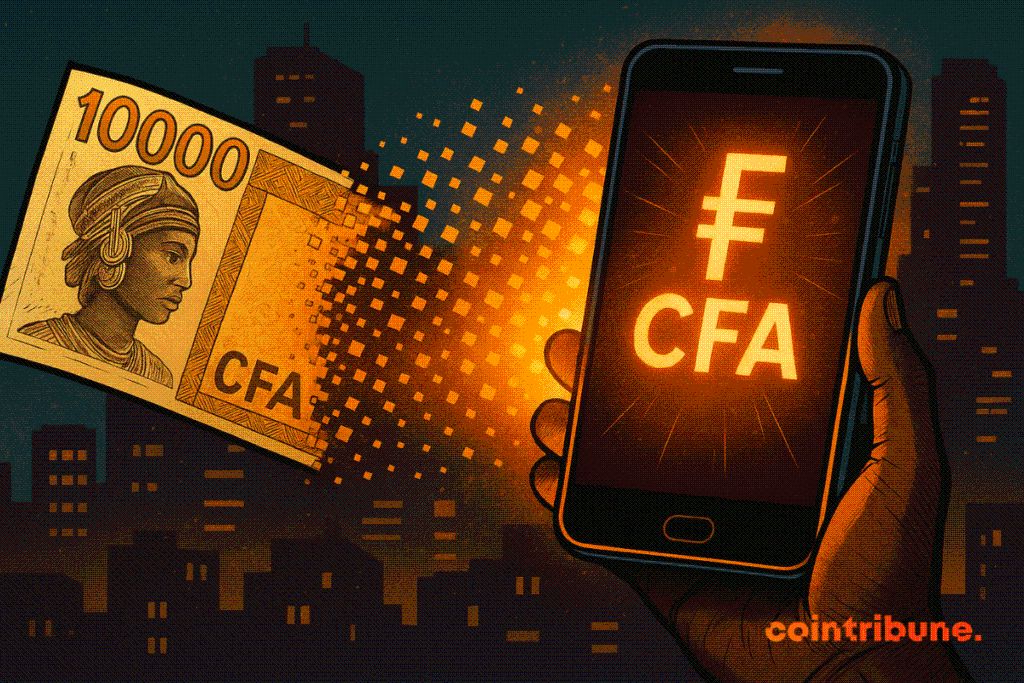
The BCEAO will launch the e-CFA: A digital version of the CFA franc for 8 countries

While several major economic powers still hesitate to adopt a central bank digital currency, West Africa is accelerating. Eight member countries of the UEMOA are about to take a step forward with the e-CFA. A technological revolution with geopolitical reach? In a region where the CFA franc crystallizes debates on the colonial legacy, this digital turn could well be the first step towards a reinvented monetary independence.
In brief
- The e-CFA will be pegged to the CFA franc, with equivalence guaranteed by the BCEAO.
- It promises fast payments, accessible even without a bank account or stable internet connection.
- Regional fintechs will have to adapt or disappear according to the evolution of the programmable model of the e-CFA.
- The project fuels the debate over monetary sovereignty within a framework still linked to the euro.
e-CFA vs cryptos: a technological duel… but not on equal footing
The BCEAO presents the e-CFA as a strategic response to the expansion of fintechs and the rise of crypto. Orange Money, Wave, or even Binance (and other platforms to buy bitcoin) already attract millions of users on the continent. To keep control, the Central Bank strikes back with its own solution: official, regulated, interoperable.
The e-CFA will be usable by card, phone, or mobile app, even offline. Objective: to also reach the unbanked, who are the majority in the region. This is a true repositioning of the institution, which seeks to regain its centrality in everyday transactions. The e-CFA promises speed, security, and inclusion. But it retains one particularity: it remains pegged to the euro. This raises strong criticism.
In an op-ed published in August 2025 , economist Adama Wade already pointed out the paradox of the e-CFA: it does not break with the inherited system, it simply digitizes its mechanisms. It modernizes dependence without offering real emancipation.
Against it, cryptocurrencies offer freedom but lack stability. The duel continues.
When bills become ghosts: revolution in our pockets
No more coins. No more bills. The e-CFA signals the progressive disappearance of paper money. This is a small revolution in markets, taxis, or neighborhood shops. Currency moves to all digital, and everyone is concerned.
But criticisms exist. Some voices point out the risks of increased control over transactions. Others fear increased state surveillance. Not to mention that the e-CFA is programmable: in theory, its use could be limited to certain expenses or durations.
In this mutation, West Africa must juggle between innovation and the preservation of individual freedoms. Crypto, even unstable, continues to attract those who want to flee centralized models.
Digital inclusion or social divide: the big test of the e-CFA
One of the flagship arguments for the e-CFA is financial inclusion. But how to include without excluding? In some rural areas, access to electricity remains uncertain. Not to mention digital illiteracy affecting a large part of the population.
To succeed, the BCEAO will have to go beyond simple technical innovation. Financial education campaigns, local partnerships, applications accessible to the most vulnerable will be essential. Otherwise, this digital currency will remain an urban luxury.
Dr. Mohamed H’Midouche warns of a very real risk: if the digital divide is not anticipated, the financial inclusion promised by the e-CFA could paradoxically turn into exclusion for the most vulnerable populations.
e-CFA: the key figures to understand
- 24%: average banking rate in UEMOA in 2023;
- 52%: population with access to financial services through mobile money;
- September 30, 2025: official launch of the PISPI platform for instant payments;
- 6%: banking rate in Niger, one of the lowest in the region;
- 90%: share of digital transactions managed by M-Pesa in Kenya (outside UEMOA).
The e-CFA opens a new era. But it’s just a beginning. Africa becomes a monetary laboratory where everything is experimented: from local stablecoin to Telegram’s ambitions, which already sees itself as the key to crypto boom on the continent . The next battle will not be fought in banks, but in the connected pockets of its citizens.
Disclaimer: The content of this article solely reflects the author's opinion and does not represent the platform in any capacity. This article is not intended to serve as a reference for making investment decisions.
You may also like
Clean Energy Market Fluidity: Ushering in a New Age with CFTC-Sanctioned Platforms
- REsurety's CleanTrade, the first CFTC-approved SEF for clean energy , is transforming market liquidity and transparency by standardizing VPPAs, PPAs, and RECs. - The platform attracted $16B in notional value within two months, enabling institutional investors to hedge energy risks while aligning with ESG goals through verifiable decarbonization metrics. - Renewable developers benefit from streamlined financing and securitization tools, creating predictable revenue streams and expanding access to capital

Investing in Human Capital for a Greener Tomorrow: The Growth of Education and Career Training in Renewable Energy
- Global energy transition drives rapid growth in renewable workforce demand, with U.S. wind turbine technician roles projected to surge 60.1% by 2033. - Institutions like Farmingdale State College bridge skill gaps through industry-aligned programs, offering hands-on training and partnerships with firms like Orsted and GE . - Investors gain strategic opportunities by funding vocational training and microcredentials, addressing decarbonization needs while boosting social equity through inclusive initiative
Clean Energy Market Fluidity: The CFTC-Endorsed Transformation
- CFTC approved CleanTrade as the first SEF for clean energy , addressing market fragmentation and liquidity gaps. - The platform enables institutional-scale trading of VPPAs and RECs with automated compliance and $16B in early trading volume. - Integrated analytics and regulatory compliance enhance transparency, reducing risks for investors in renewable energy assets. - Early adoption by Cargill and Mercuria highlights CleanTrade's potential to reshape $1.2T clean energy investment landscape.

How iRobot Strayed from Its Original Path
Trending news
MoreCrypto prices
More





