
Gold’s $4,000 Rally Echoes the Nixon Era — and Bitcoin Is the Modern Winner

Gold futures has surged past $4,000, marking its fastest rise since the Nixon Shock era. As investors hedge against inflation and a weakening dollar, both gold and Bitcoin are emerging as key safe-haven assets in a new wave of fiat skepticism.
Gold futures have climbed past $4,000 per ounce, marking their fastest rise since the years following the Nixon Shock.
This surge, amid persistent inflation, rising unemployment, and a weakening dollar, has reignited concerns about a potential crisis in fiat currency confidence, with investors turning to safe-haven assets like gold and Bitcoin (BTC).
A Signal from the 1970s? Gold’s Record Surge Echoes the Nixon Shock
For context, the Nixon Shock was a turning point in global finance. In 1971, President Richard Nixon suspended the dollar’s convertibility into gold, effectively ending the Bretton Woods system.
This was a post-World War II framework that had tied major currencies to the US dollar, which itself was pegged to gold at $35 per ounce. Its collapse unleashed rampant inflation and eroded trust in the dollar, propelling gold prices upward in a rapid ascent.
According to market commentary from The Kobeissi Letter, gold futures’ rally since February 2024 mirrors the dynamics of the 1970s.
“In February 2024, gold hit $2,000/oz in what seemed to be a historic move. 19 months later, gold prices have doubled in their fastest move since the 1970s. The last time gold DOUBLED in under 2 years was in the 1970s after the historic Nixon Shock,” the post read.
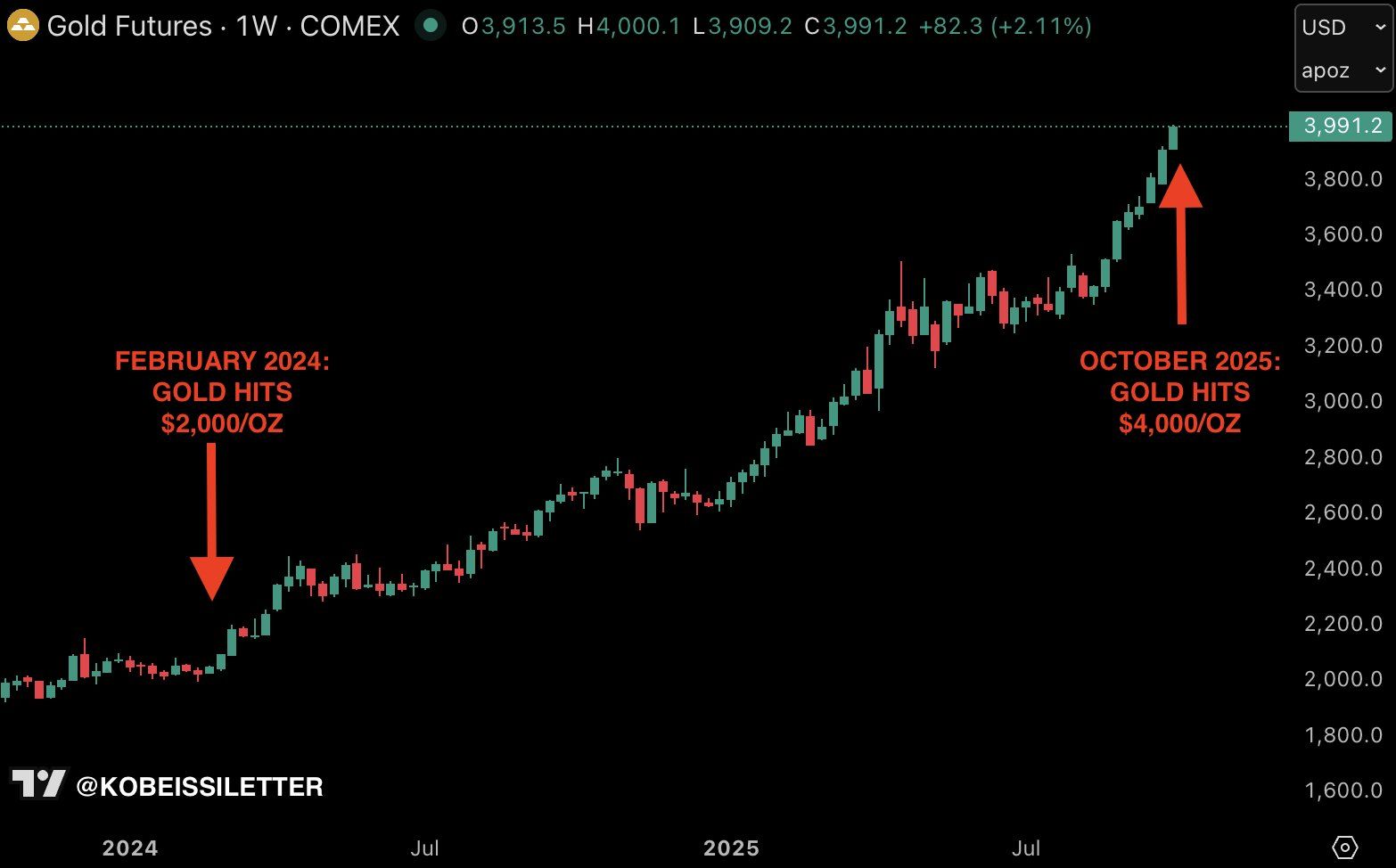 Gold’s Rally. Source:
The analysis highlighted that the US M2 money supply has skyrocketed alongside gold prices, fueled by trillion-dollar deficits and low interest rates. Recent data exacerbates these fears: the US Dollar Index has fallen 10% year-to-date.
This has marked its steepest drop in four decades. Meawhile, unemployment exceeds job openings by 157,000—the widest gap since March 2021.
“JOLTs quits in leisure and hospitality have collapsed to levels only seen in 2020 and 2008. Gold knows the Fed can’t ignore this,” The Kobeissi Letter added.
Furthermore, inflation persists, with 60% of Consumer Price Index items rising by at least 3%. The Federal Reserve is also cutting rates despite the risk of reigniting price pressures. This scenario evokes stagflation, where sluggish growth coincides with high inflation, a hallmark of the 1970s economic turmoil.
As these warning signs multiply, institutional investors are beginning to reposition, signaling that the recent gold rally may be more than just a short-term flight to safety.
“For the first time in over a decade, Wall Street is piling into gold. Goldman Sachs just raised its 2026 gold price target to $4,900/oz. The bank says continued buying from ETFs and Central Banks is durable. Institutional capital is looking to hedge against inflation,” the post revealed.
Bitcoin As a Modern Parallel To Gold
While gold’s resurgence underlines waning faith in fiat systems, Bitcoin, often dubbed ‘digital gold,’ is also emerging as a parallel beneficiary of this trend. Deutsche Bank analysts Marion Laboure and Camilla Siazon forecast that both assets could integrate into central bank reserves by 2030.
“A strategic Bitcoin allocation could emerge as a modern cornerstone of financial security, echoing gold’s role in the 20th century. Assessing volatility, liquidity, strategic value and trust, we find that both assets will likely feature on central bank balance sheets by 2030,” they said.
The analysts argued that Bitcoin’s volatility has reached historic lows. This reinforces its reputation as a reliable store of value.
At the same time, a growing number of corporations—most notably (Micro) Strategy—are adding Bitcoin to their balance sheets. This signals rising institutional confidence and a shift toward digital reserve assets.
Disclaimer: The content of this article solely reflects the author's opinion and does not represent the platform in any capacity. This article is not intended to serve as a reference for making investment decisions.
You may also like
The 2025 Bitcoin Collapse: Underlying Factors and Tactical Considerations for Cryptocurrency Investors
- The 2025 Bitcoin crash erased $1.2 trillion in value, driven by macroeconomic tightening, leverage, and geopolitical tensions. - Financialization linked crypto to traditional markets, exposing systemic risks through institutional entanglements and fragile liquidity. - Regulatory divergence between U.S. pro-blockchain policies and EU MiCAR rules created jurisdictional conflicts and operational misalignment. - Investors must prioritize diversification, monitor regulatory shifts, and prepare for prolonged v

Blockchain’s $6.8 Billion Bet: Will Advancements Outpace Its Security Risks?
- Terminal Finance's collapse exposed blockchain fintech vulnerabilities from delayed tech adoption and security flaws, triggering sector-wide scrutiny. - Naver-Upbit's $6.8B AI-blockchain merger faces challenges after Upbit's $36M Solana breach, mirroring 2019 North Korean-linked attacks. - Balancer's $116M hack revealed systemic DeFi risks, with debates over audit efficacy despite 11 prior security reviews. - Binance's legal troubles and BNB's price slump highlight market skepticism, while initiatives li

Bitcoin News Update: Krugman Links Bitcoin's Decline to Waning 'Trump Trade' Hype
- Bitcoin's 30% drop from October peak linked to fading "Trump trade" speculation, per Nobel laureate Paul Krugman, who frames it as speculative rather than stable value. - BlackRock's IBIT ETF regained $3.2B profit post-$90K rebound, while SpaceX's $105M BTC transfer sparks custodial strategy debates amid market volatility. - Naver's $10B Dunamu acquisition and corporate Bitcoin treasury moves highlight institutional crypto integration, despite $19B industry selloff and regulatory challenges. - Prediction

Bitcoin News Today: "Conflicting Whale Strategies Cast Uncertainty on Bitcoin's Path to $100K"
- Bitcoin's drop below $100,000 coincided with mixed whale strategies, including accumulation, shorting, and exchange deposits, signaling uncertain market direction. - Ethereum whales used 16.08 million DAI to buy 5,343 ETH at $3,010, while Bitcoin whales deposited 9,000 BTC, potentially signaling selling preparation. - Derivatives markets showed conflicting bets, with a $91M BTC short and $36.4M long flip, while ETF inflows ($84M total) hinted at institutional confidence amid macroeconomic risks. - Analys

Trending news
MoreCrypto prices
More





