
Weekly Hot Picks: Bank of Japan Sends Strongest Rate Hike Signal! Is the Copper Market Entering a Supercycle Rehearsal?

The leading candidate for Federal Reserve Chair is being questioned for potentially "accommodative rate cuts." Copper prices have reached a historic high, and a five-hour meeting between the United States and Russia ended without results. Expectations for a Japanese interest rate hike in December have surged, and Moore Threads' stock soared more than fivefold on its first day... What market moves did you miss this week?
Market Review
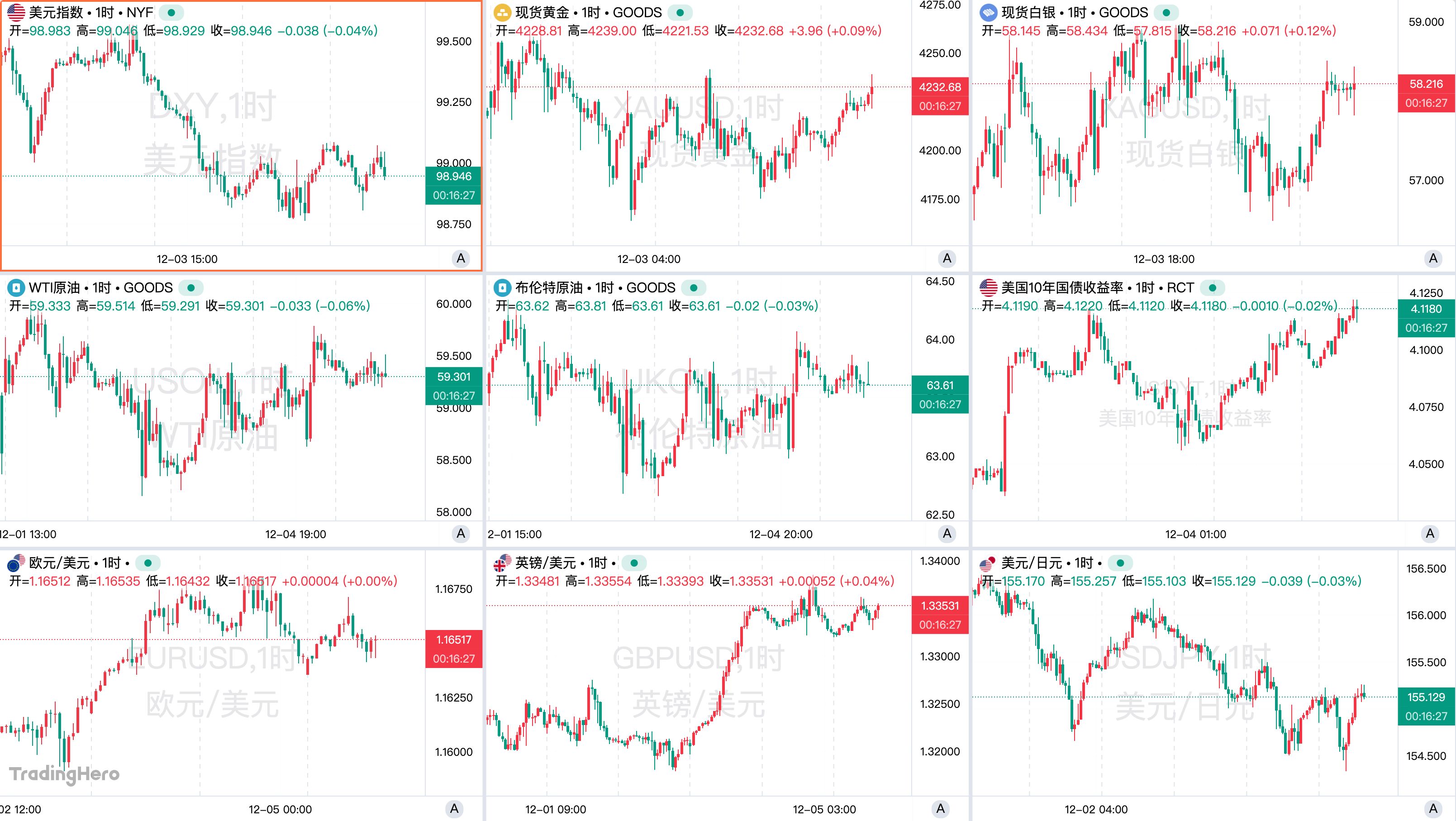
US Dollar Index fluctuated and weakened throughout the week, declining for three consecutive days at the beginning of the week as the market continued to ramp up bets on a Fed rate cut next week. On Thursday, initial jobless claims data was significantly better than expected, causing a slight rebound in the dollar, but overall it remained near a five-week low. At the time of writing, the dollar index was at 98.95.
In precious metals, overall, gold prices consolidated at high levels, while silver was more volatile but showed a stronger trend. At the start of the week, gold rose to a six-week high supported by a weak dollar and rate cut expectations, while silver approached $59, hitting a record high, mainly due to supply shortages and surging industrial demand. However, both gold and silver entered a period of fluctuation due to profit-taking and employment data. At the time of writing, spot gold and silver were quoted at $4,233 and $58.22 per ounce, respectively.
For non-US currencies, under the general pressure on the dollar this week, the euro, pound, and AUD/USD all showed varying degrees of appreciation; among them, the Australian dollar and the pound performed relatively strongly, and the euro also rose steadily. Due to the significantly increased probability of a Bank of Japan rate hike in December, USD/JPY is expected to post its largest weekly drop since the end of September.
The core driver of international oil prices came from geopolitics. On Monday, pipeline damage and the situation in Venezuela pushed up risk premiums, causing oil prices to surge. Subsequently, the market fluctuated sharply, with profit-taking leading to a brief pullback, but as the market judged that Russia-Ukraine peace talks were unlikely to ease sanctions in the short term, oil prices rebounded again.
US stocks overall fluctuated with a bullish bias. This week, the three major US stock indexes continued their usual mild year-end upward trend, with investor confidence partially restored and expectations of Fed rate cuts becoming the main driving factor. The S&P and Dow performed relatively steadily, while the Nasdaq rose but to a limited extent.
Selected Investment Bank Views
Bank of America adjusted its Fed rate cut forecast, believing that a 25 basis point cut is likely in December, with two more cuts in 2026.
JPMorgan maintains its multi-year bullish outlook on gold, predicting that by 2026, sustained strong demand from central banks and investors will push gold prices to $5,000 per ounce.
The World Gold Council analysis suggests that gold prices may fluctuate within a range next year, but strong momentum cannot be ruled out.
Goldman Sachs stated that copper's breakout above $11,000 lacks fundamental support, and it holds a pessimistic outlook for aluminum, lithium, and iron ore in 2026. However, Citi is optimistic about copper, aluminum, and tin prices in 2026.
Deutsche Bank believes that if the next Fed chair fails to effectively address inflation risks, the dollar may face downward pressure.
Weekly Major Events
1. Hassett questioned for potential “pleasing rate cuts”! Is next week's rate cut a foregone conclusion?
After canceling the originally scheduled interviews for Fed chair candidates this week, Trump reportedly plans to announce the new Fed chair at the beginning of 2026 and has hinted that National Economic Council Director Hassett is highly likely to be nominated.
However, the market is skeptical, worrying that Hassett may aggressively cut rates to please Trump. If Hassett is ultimately nominated as Fed chair, he will need Senate approval.
In addition, foreign media analysis suggests that after Powell ends his term as chair, he may continue to serve as a Fed governor until January 2028 to continue defending the Fed’s independence.
Although Hassett is a hot candidate, Trump said he is not the first choice; he originally wanted Treasury Secretary Besant to take over, but Besant declined.
It is understood that Trump’s aides and allies are reportedly discussing that if Hassett becomes Fed chair, Treasury Secretary Besant may also serve as White House National Economic Council Director. Besant is reportedly planning to push for Fed reforms, requiring regional Fed chair candidates to have lived in their districts for at least three years.
This week’s data showed that US initial jobless claims fell to 191,000, a three-year low, indicating labor market resilience. The market believes that this gives the Fed room to cut rates, with the probability of a December rate cut rising sharply. Traders are betting over 90% odds of a 25 basis point cut next week. Hassett also stated this week that there seems to be a consensus at the Fed for a 25 basis point rate cut next week.
Powell attended an event and gave a speech on Tuesday, but did not address monetary policy. The Fed will announce its December rate decision at 3 a.m. next Thursday.
2. Bank of Japan sends strongest rate hike signal! Has Sanae Takaichi given tacit approval?
Bank of Japan Governor Kazuo Ueda issued the clearest rate hike signal to date this week. The bank will hold a monetary policy meeting from December 18 to 19, when it may implement the first rate hike since January this year, raising the policy rate from 0.5% to 0.75%, the highest in thirty years.
Ueda stated that the central bank will “weigh the pros and cons of raising the policy rate by examining domestic and international economic, inflation, and financial market conditions, and make timely decisions.” He added that the likelihood of achieving the economic outlook is rising, and even if the policy rate is raised, financial conditions will remain accommodative.
Ueda also rarely mentioned smooth communication with Prime Minister Sanae Takaichi, hinting that the government has tacitly approved tightening policy to stabilize inflation. As the year-end approaches, yen depreciation pressure is rapidly increasing. Even Takaichi’s reflationist advisers have not expressed opposition to a rate hike. Government advisory panel member Toshihiro Nagahama said that if the yen remains weak, the prime minister may accept a December rate hike.
The strong rate hike signal triggered a sell-off in Japanese stocks and bonds. The bond market, most sensitive to rate hikes, saw a direct sell-off of government bonds following Ueda’s remarks, causing the yield curve to rise significantly. The yield on newly issued 10-year Japanese government bonds once rose to its highest level since July 2007.
The market is concerned about a reversal of yen carry trades, but analysts believe the impact this time may be smaller than last year. Carry trade positions have decreased, rate hike expectations are partially priced in, and global spillover risks are controllable.
3. Global copper prices soar to record highs, LME sees largest warrant cancellations in a decade
Recently, global copper prices have soared to record highs driven by multiple factors. Strong US demand for refined copper has led to a global inventory mismatch, with LME stocks falling below the critical 100,000-ton threshold and spot premiums intensifying.
This copper price surge is mainly influenced by several factors. First, tightening global copper supply is the main driver. A mine collapse in Chile led Glencore to lower this year’s copper production to 850,000–875,000 tons, nearly 40% less than in 2018, and the company also lowered its 2026 copper output forecast.
Second, the market widely predicts that the Trump administration may impose tariffs on copper next year. To avoid tariffs, large quantities of metal have recently been shipped to the US, potentially causing global copper inventories to soon fall to dangerously low levels.
In addition, global demand for copper is strong, especially with the rapid development of AI, which has led to explosive growth in demand for grid and power infrastructure upgrades, also an important reason for the copper price surge. According to the International Energy Agency, even under high production scenarios, the global copper supply gap will still reach 20% by 2035.
Large-scale physical withdrawals and sharp inventory declines have further intensified market concerns about future supply shortages, pushing up both copper prices and spot premiums.
London Metal Exchange (LME) Asian warehouse canceled warrant volumes surged to a ten-year high. Among them, commodity trading giant Mercuria Energy Group withdrew about 50,000 tons of copper, worth about $500 million, from LME-regulated warehouses. This move is the largest in more than a decade and directly pushed LME copper prices close to a record high of over $11,500 per ton.
JPMorgan believes this event marks copper prices entering a more volatile and clearly upward-trending mid-stage. As long as the threat of US tariffs on refined copper persists, the downward trend in LME inventories will be hard to reverse.
4. Five-hour US-Russia talks yield no results! Putin visits India afterward
This week, Russian President Putin met with US envoy Whitcoff and Trump’s son-in-law Kushner at the Kremlin. The talks lasted nearly five hours and aimed to discuss a peaceful solution to the Russia-Ukraine conflict.
Kremlin senior aide Yuri Ushakov said that although the talks were “very useful and constructive,” the two sides still failed to find a compromise on the issue of Ukrainian territory. Trump said the meeting between US envoy Whitcoff and Putin was quite good, but he did not know what the final outcome would be.
The US delegation visited the Russian capital to discuss a revised peace plan. Previously, a leaked US “28-point” peace plan draft was strongly criticized by Ukraine and its allies for favoring Russia.
Putin reportedly refused to accept parts of the peace plan and warned that if attacks on Russian oil tankers continued to surge, Russia might consider striking ships belonging to countries supporting Ukraine.
Ukrainian President Zelensky said the new peace plan is better than the original version and will discuss key issues in the draft with Trump. Ukrainian envoys are heading to the US for a new round of talks. The EU has warned the US not to pressure Ukraine on the peace agreement.
In addition, Putin visited India this week, challenging US pressure on India’s purchase of Russian oil. Putin pointed out that the US itself imports Russian nuclear fuel, so India should have the same rights. The visit aims to strengthen Russia-India relations; India’s imports of Russian oil have soared to 36%, making it the second-largest buyer and saving significant costs. Despite US pressure, Russia and India still plan to advance cooperation in multiple fields.
5. Trump updates: Tightening immigration, considering robotics executive order, may exit USMCA next year
The Trump administration plans to expand the travel ban to about 30 countries, further restricting immigration. This move stems from an incident in which two National Guard members in Washington were attacked, resulting in one death and one serious injury. Trump posted on his social platform that he would “permanently suspend all immigration from third world countries.”
The US Citizenship and Immigration Services has suspended processing immigration applications from 19 restricted countries and will comprehensively review approvals for entrants since Biden took office, with a new list to be announced soon.
The government is also tightening work visas for immigrants, reducing work permits for asylum seekers and similar programs from five years to 18 months, which may affect hundreds of thousands of industries relying on such labor, causing concern among immigration advocates and employers.
After five months of focusing on AI, the Trump administration is shifting its focus to robotics. Sources say Commerce Secretary Lutnick has been meeting intensively with robotics industry executives to accelerate development, and related executive orders may be issued next year.
The US Department of Transportation will also establish a robotics task force, and Congress is advancing related legislation. Although the amendment to establish a National Robotics Commission was not enacted, follow-up actions are still underway.
US Trade Representative Greer said that although the USMCA encourages maintenance until 2036, Trump may exit or split the agreement next year. He pointed out that Trump only pursues “profitable deals” and had considered tearing up NAFTA, proposing that the US negotiate separately with Canada and Mexico, arguing that the economic relationships among the three countries are vastly different and combining them is of limited significance.
6. Moore Threads surges over 500% on first trading day! Market cap briefly exceeds 300 billions yuan
As the “first domestic GPU stock,” Moore Threads successfully listed on the STAR Market on December 5, with an extremely impressive debut. On the first trading day, Moore Threads’ intraday gain reached 502.03%, with the stock price peaking at 688 yuan per share and the total market cap briefly exceeding 300 billions yuan. Its issue price was 114.28 yuan per share, so one lot (500 shares) could earn up to about 286,900 yuan.
Moore Threads’ IPO process can be described as “STAR Market speed.” On June 30, 2025, Moore Threads’ STAR Market IPO application was accepted, passed the review on September 26, received CSRC registration approval on October 30, IPO subscription on November 24, and successfully listed on December 5, taking only 158 days in total.
The company has also developed rapidly since its founding, launching the first domestic full-featured GPU in 2021, achieving operating income of over 400 millions yuan in 2024, and a compound annual growth rate of over 200% in the past three years. In the first half of 2025, the company achieved revenue of 702 millions yuan.
7. Google and Anthropic squeeze OpenAI, which enters “red code” mode to improve ChatGPT
OpenAI is facing unprecedented competitive pressure, with its industry-leading position being challenged.
To cope with the competition, OpenAI CEO Altman announced that the company has entered “red code” mode, focusing on improving ChatGPT and postponing other plans, including advertising. Previously, OpenAI had tried to commercialize by launching the AI browser Atlas, music generation tools, etc., but its profit model remains unclear.
Last month, Google released its so-called “smartest” AI model, Gemini 3, which topped the global AI model LMArena rankings with a record score of 1501 and outperformed OpenAI’s GPT-5.1 in several academic-level benchmarks.
Thus, the issuer of the “red alert” in the AI track has quietly changed. Three years ago, Google issued a “red alert” due to the rise of ChatGPT; now, OpenAI has issued a “red alert” due to the strong performance of Google’s Gemini 3.
Meanwhile, AI startup Anthropic has reached a $350 billions strategic partnership with Microsoft and Nvidia, further enhancing its R&D and commercialization capabilities and weakening OpenAI’s advantage in computing resources.
This week, it was reported that Anthropic has hired the well-known law firm Wilson Sonsini to prepare for its IPO, which could take place as early as 2026.
8. Amazon releases Trainium 3 AI chip, Jensen Huang’s “anxiety” never changes
To challenge Nvidia and Google, Amazon released its new generation AI chip Trainium 3 and Nova 2 series models at AWS re:Invent. Trainium 3 uses 3nm technology, delivers 2.52 PFLOPs of computing power, and improves energy efficiency by 40%. The Nova 2 series covers inference, multimodal processing, conversational AI, and more, and also launched the “open training” service Nova Forge and browser task automation service Nova Act, aiming to improve AI performance and cost-effectiveness.
Nvidia CEO Jensen Huang revealed on a podcast that he works seven days a week, checks emails at 4 a.m., and does not rest even on Thanksgiving or Christmas, always feeling “only 30 days away from bankruptcy.” Despite Nvidia’s market cap exceeding $5 trillions, he is still driven by the anxiety of being “wiped out overnight.”
9. Tesla targeted by “Big Short”! Valuation and compensation plan in the spotlight
Investor Michael Burry, the prototype for the movie “The Big Short,” has once again shorted Tesla, calling its valuation “absurdly high” and criticizing Tesla’s compensation plan for further diluting shareholder equity.
Burry estimates that Tesla’s stock-based compensation plan, without buybacks to offset it, dilutes shareholder equity by about 3.6% per year. He specifically criticized Musk’s $1 trillion compensation plan, arguing that its scale and potential dilution effect have become a focus for institutional investors assessing company risk.
Burry also noted that Tesla’s business focus has shifted multiple times in recent years: from initially focusing on electric vehicle manufacturing, to later betting on autonomous driving technology, and now doubling down on humanoid robot development. Each strategic shift has been accompanied by market hype, but the company has never escaped the pressure of continuous new entrants, and its core business moat remains unstable.
In addition, as Tesla’s sales in the European market remain sluggish, it announced the launch of a lower-priced Model 3 to expand market share and attract more consumers.
10. 5-year large certificates of deposit “disappear”—why are banks collectively changing their stance?
Recently, 5-year large certificate of deposit products have collectively “disappeared” from the mobile banking apps of many banks. State-owned banks such as ICBC and CCB, as well as joint-stock banks like Industrial Bank and China Merchants Bank and city commercial banks, all have no 5-year large CD products on their apps. Some banks’ 3-year large CDs are also sold out, with only 1-year and shorter-term products still available.
Industry insiders say that this phenomenon is not accidental, but an inevitable choice for the banking industry in response to the current economic environment. On one hand, bank lending rates continue to fall, narrowing returns on the asset side; on the other hand, deposit competition is fierce, and liability costs remain high. This “squeeze from both ends” has forced banks to adjust their long-term deposit products.
Disclaimer: The content of this article solely reflects the author's opinion and does not represent the platform in any capacity. This article is not intended to serve as a reference for making investment decisions.
You may also like
Ethereum’s major 2025 upgrade completed: a faster and cheaper mainnet has arrived
On December 4, Ethereum's second major upgrade of the year, Fusaka (corresponding to Epoch 411392), was officially activated on the Ethereum mainnet.
Durov's new project: Want to mine TON on Cocoon? Ordinary people can't afford to play
Want to mine TON on Cocoon? The starting capital is 250,000; ordinary people shouldn't dream of becoming a "computing power landlord."

"If you're afraid, buy bitcoin": BlackRock CEO calls bitcoin a "panic asset", says sovereign funds have quietly increased their holdings
BlackRock CEO Larry Fink defines Bitcoin not as a "hope asset," but as a "panic asset."
Stablecoin Legislation Booms Globally, Why Is China Taking the Opposite Approach? An Article to Understand the Real National Strategic Choices
Amid the global surge in stablecoin legislation, China has chosen to firmly curb stablecoins and other virtual currencies, while accelerating the development of the digital yuan to safeguard national security and monetary sovereignty. Summary generated by Mars AI. This summary is produced by the Mars AI model and its accuracy and completeness are still being iteratively improved.
Trending news
MoreCrypto prices
More





