
After more than 100 basis points of rate cuts, the Federal Reserve is considering how to stop, but the disagreements are unprecedented.

There is an ongoing debate within the Federal Reserve regarding the endpoint of monetary policy easing. The main points of contention are whether the economy requires further stimulus and the precise level of the "neutral interest rate."
There is an ongoing debate within the Federal Reserve regarding the endpoint of policy easing, with the main point of contention being whether the economy requires further stimulus and the precise location of the "neutral interest rate."
Written by: Zhang Yaqi
Source: Wallstreetcn
After implementing more than a percentage point in rate cuts, officials at the Federal Reserve are now facing a thorny question: where is the endpoint of policy easing?
This divergence is evolving into an unusually public debate, which not only concerns whether there will be another rate cut next week, but also the direction of future policy. Federal Reserve Chair Jerome Powell has acknowledged that there are "strongly differing views" within the committee on how to balance the dual goals of stabilizing prices and maximizing employment.
The core of the debate is whether the economy needs more stimulus to support the job market, or whether, given that inflation remains above target and tariffs could further push up prices, policymakers should pause. This situation makes every potential rate cut increasingly difficult and contentious.
Behind all of this, a more abstract yet increasingly important question has emerged: what level of interest rate neither stimulates nor restrains the economy? This theoretical endpoint, known as the "neutral interest rate," has become a focal point on which Federal Reserve officials are struggling to reach consensus.
Diverse Opinions Abound, Neutral Rate Becomes the Focus
The "neutral interest rate" is a core concept in monetary policy theory; it cannot be directly observed and can only be inferred through models. At present, Federal Reserve policymakers are working hard to determine its specific level.
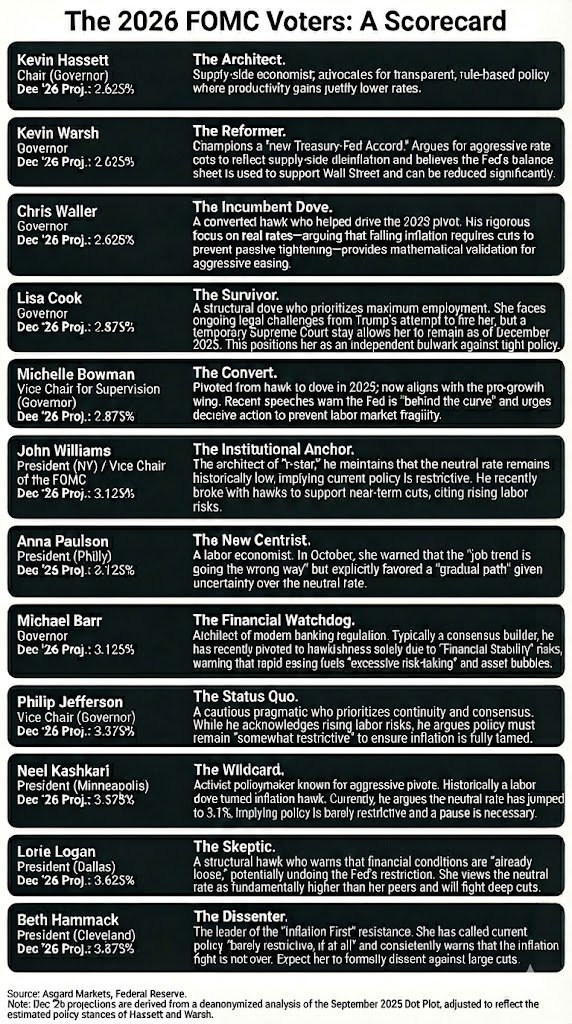
In the latest forecasts released in September, 19 officials provided 11 different estimates for the neutral rate, ranging from 2.6% to 3.9%. Data shows this is the widest divergence in views on the ultimate direction of rates since the Federal Reserve began publishing such forecasts in 2012. Stephen Stanley, Chief US Economist at Santander Bank, stated, "We are seeing officials' views all over the map."
Stanley believes that as the Fed's benchmark rate has reached the upper end of the forecast range, the importance of the neutral rate estimate is becoming increasingly prominent. He said, "For some of the more hawkish Fed members, this is starting to become a potential binding constraint," meaning "each subsequent rate cut will become more and more difficult."
Philadelphia Fed President Anna Paulson also expressed similar caution in her speech on November 20. She said that the dual risks of inflation and unemployment, coupled with the possibility that rates are already close to neutral, made her cautious about the December meeting. She warned, "Monetary policy must walk a tightrope," because "each rate cut brings us closer to the point where policy shifts from slightly restraining activity to starting to provide stimulus."
In addition to differing views on the current level of the neutral rate, officials also disagree on its future trajectory. It is generally believed that the neutral rate is driven by long-term factors such as demographics, technology, productivity, and debt burdens.
Minneapolis Fed President Neel Kashkari predicts that the widespread adoption of artificial intelligence will lead to faster productivity growth, thereby raising the neutral rate as new investment opportunities boost capital demand.
However, newly appointed Fed Governor Stephen Miran believes that short-term policy should also be taken into account. In his first policy speech after taking office, he argued that Trump's tariffs, immigration restrictions, and tax cuts combined have (even if only temporarily) lowered the neutral rate, so the Fed should significantly ease policy to avoid harming the economy. In contrast, New York Fed President John Williams is skeptical about factoring short-term changes into the calculation, believing that global trends such as population aging are keeping the neutral rate estimate at historically low levels.
Different Interpretations of Market Signals, Divergence May Become the Norm
Since the neutral rate cannot be directly observed, some policymakers prefer to judge its impact through market and economic indicators. St. Louis Fed President Alberto Musalem believes that low default rates indicate that financial conditions remain supportive of the economy. His Cleveland Fed colleague Beth Hammack said that narrow credit spreads mean that monetary policy "even if tight, is only barely so."
However, interpreting clues from financial markets is not easy. Some officials see the 10-year US Treasury yield hovering around 4% as evidence that financial conditions are not restraining the economy. But others counter that these yields reflect expectations about the economic path and strong global demand for safe assets, and thus have little reference value in estimating the neutral rate.
Analysts point out that post-pandemic price surges, uncertainty in trade and immigration policy, and the unknown impact of artificial intelligence on the economy all make some wonder whether divergence of views will become the new normal. In addition, the Fed will see a leadership change in 2026, and Trump has vowed to appoint a new chair committed to lowering rates, which could bring more policymakers like Miran who advocate for cheap money.
It is worth noting that although the theoretical debate about the neutral rate is intense, in actual decision-making it may not be the decisive factor. Patrick Harker, former Philadelphia Fed President who retired this year, said the neutral rate is "a useful conceptual tool, but it is just a tool and does not drive policy decisions." He added that he could not recall any meeting where the entire discussion revolved around what the neutral rate is.
In Harker's view, what truly drives policy decisions will be more concrete things—"labor data and price data." This provides the market with a perspective: no matter how great the theoretical divergence, what ultimately affects investors' wallets will still be the economic reports released in the coming months.
Disclaimer: The content of this article solely reflects the author's opinion and does not represent the platform in any capacity. This article is not intended to serve as a reference for making investment decisions.
You may also like
2026: The Year of Federal Reserve Regime Change
The Federal Reserve will shift away from the technocratic caution of the Powell era, moving toward a new mission that clearly prioritizes lowering borrowing costs to advance the president’s economic agenda.
Over $756M In 11 days : XRP ETF Break Records

BTC Lags Behind Global Money Growth

Shiba Inu: Shibarium Privacy Upgrade Targets 2026

Trending news
MoreCrypto prices
More






