
Ethereum News Today: Ethereum's ZK Privacy Initiative Seeks to Meet Regulatory Requirements While Preserving User Anonymity
- Ethereum developers are advancing a ZK protocol inspired by Secret Santa to enhance on-chain privacy, addressing transparency challenges. - The protocol uses zero-knowledge proofs and relayers to anonymize transactions, solving address visibility, randomness gaps, and Sybil attack risks. - Applications include anonymous DAO voting and private token distributions, balancing regulatory demands like EU's 2025/2263 data-sharing rules. - Vitalik Buterin warns of surveillance risks without privacy upgrades, wh
Ethereum Explores Zero-Knowledge Protocol for Enhanced Blockchain Privacy
Ethereum developers are working on a new zero-knowledge (ZK) protocol, inspired by the Secret Santa gift exchange, to address privacy concerns on the blockchain. This innovative approach, spearheaded by Solidity engineer Artem Chystiakov and his team, is designed to allow users to interact anonymously, concealing both the identities of participants and the details of their transactions. The move comes as the Ethereum ecosystem increasingly intersects with regulated financial institutions, driving demand for privacy-focused solutions.
The proposed protocol utilizes ZK proofs and transaction relayers to tackle three major challenges: public visibility of Ethereum addresses, lack of genuine randomness, and vulnerability to Sybil attacks. Participants register their Ethereum addresses through a smart contract and commit unique digital signatures to avoid duplicate entries. To further obscure identities, random numbers are submitted via relayers. Recipients then use these numbers to encrypt delivery information, ensuring only their designated sender can access it. This process closely resembles the traditional Secret Santa game, where participants contribute anonymously to a shared pool.

How the Protocol Works
- Step 1: Users register and commit their signatures.
- Step 2: Random numbers are submitted anonymously through relayers.
- Step 3: Pairings are finalized, with only the assigned sender learning the recipient's identity.
This system is designed to prevent participants from being matched with themselves and ensures trustless operation. It relies on advanced cryptographic techniques, including hash functions, ECDSA signature recovery, and Merkle proofs, to guarantee the integrity of the process.
Broader Applications and Regulatory Context
The potential uses for this privacy framework extend well beyond festive games. Zero-knowledge protocols like ZKSS could support anonymous voting in decentralized autonomous organizations (DAOs), confidential token distributions, and secure whistleblower platforms where users must prove membership without revealing their identities. These capabilities are increasingly vital as global regulators tighten oversight. For example, the Financial Stability Board has noted that strict privacy rules can complicate crypto regulation, and new EU regulations will soon require data sharing for large crypto transfers.
Ethereum’s privacy enhancements aim to strike a balance between confidentiality and regulatory compliance, enabling private transactions that remain auditable when necessary.
Ongoing Development and Future Prospects
Vitalik Buterin, Ethereum’s co-founder, has underscored the importance of strong privacy protections, warning that without them, Ethereum could become a tool for mass surveillance. The Ethereum Foundation’s Privacy Cluster, launched last October, is accelerating efforts in areas like private transactions and selective identity disclosure. Meanwhile, projects such as RAILGUN and Aztec Network are already providing shielded balances, allowing only account holders to view their transaction histories.
According to Chystiakov, open-source versions of the protocol are under development, though a release date has not yet been set. The ultimate success of this initiative will depend on overcoming challenges related to scalability and transaction costs, all while preserving Ethereum’s security. If successful, the ZKSS protocol could establish Ethereum as a frontrunner in privacy-centric blockchain technology, offering a solution that bridges the divide between transparency and confidentiality in a regulated digital landscape.
Disclaimer: The content of this article solely reflects the author's opinion and does not represent the platform in any capacity. This article is not intended to serve as a reference for making investment decisions.
You may also like
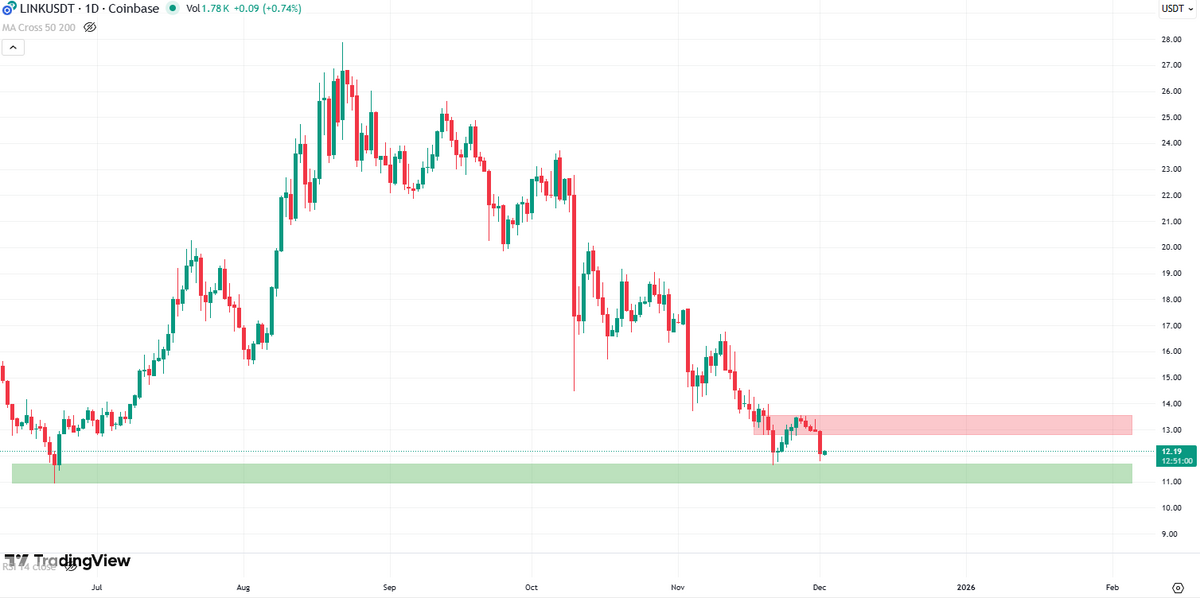
Chainlink ETF Set to Debut as LINK Slips Amid Market Weakness
Striking baristas win $38.9 million in compensation, yet contract disputes continue
- Starbucks settles NYC Fair Workweek Law violations for $38.9M, including $35.5M restitution to 15,000+ workers. - Striking baristas demand collective bargaining amid ongoing labor disputes and unionization efforts at 550 stores. - Mayor-elect Mamdani and Sen. Sanders join protests, framing demands as moral issues against corporate resistance. - Settlement addresses 500,000 scheduling violations since 2021, with workers receiving $50/week compensation. - Starbucks defends labor law complexity but faces cr

Alphabet's AI-driven ecosystem accelerates flywheel momentum, driving shares up by 68% in 2025
- Alphabet's stock surged 68% in 2025, outperforming peers like Microsoft and Nvidia , driven by strong AI monetization and cloud growth. - Analysts raised price targets to $375-$335, citing Google Cloud's $15.2B Q3 revenue (34% YoY) and $155B cloud backlog growth. - The company's AI ecosystem spans Search, YouTube, and Workspace, generating premium subscriptions and ad yield through Gemini's 650M MAUs. - Projected cloud revenue could exceed estimates by $40B, but risks include regulatory scrutiny and comp

XRP News Today: Vanguard Changes Position on Crypto ETFs, Pointing to Market Maturity and Increased Demand
- Vanguard Group will enable crypto ETF trading on its platform from December 2, 2025, reversing years of opposition to digital assets. - The firm supports Bitcoin , Ethereum , XRP , and Solana ETFs but excludes memecoins, treating crypto as non-core assets like gold . - Market maturation, $25B+ ETF inflows, and regulatory compliance drive the shift, positioning Vanguard as the last major U.S. broker to adopt crypto ETFs. - The move reflects growing institutional confidence in regulated crypto structures a
Trending news
MoreCrypto prices
More





