Written by: Micah Zimmerman
Translation: AididiaoJP, Foresight News
Elon Musk, CEO of Tesla and SpaceX, has once again sparked discussion about bitcoin, describing it as an energy-based, "fundamental currency based on physics."
In a recent podcast conversation with Nikhil Kamath, Musk emphasized that bitcoin's value is closely linked to real-world energy consumption, highlighting the differences between digital assets and traditional fiat currencies.
"Energy is the real currency," Musk said. "That's why I say bitcoin is energy-based. You can't get energy by legislation. You can't just have a law and suddenly have a lot of energy."
The Tesla founder drew attention to the difficulty of producing and utilizing energy, linking it to bitcoin's "proof-of-work" system, which requires significant computing power and electricity to maintain network security.
He also mentioned the Kardashev scale, a method of measuring a civilization's level of energy consumption, as a perspective for understanding social progress. He believes that assessing a civilization's development by its ability to generate and manage energy aligns with bitcoin's design principles, where value is supported by scarcity and computational input.
Looking further into the future, Musk suggested that advances in artificial intelligence and robotics could make money unnecessary.
"In a future where anyone can have anything, I don't think you need money as a database for labor allocation anymore," he said, referencing Iain M. Banks' 'Culture' series of novels depicting a post-scarcity era, viewing it as a blueprint: in that society, superintelligent machines manage resources without a monetary system.
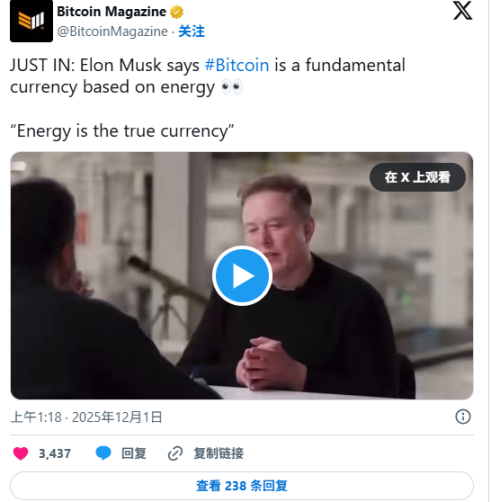
Musk: You Can't "Print" Energy
Musk also highlighted bitcoin's unique attributes. Unlike fiat currencies that governments can print at will, bitcoin's "proof-of-work" system ties its creation process to energy and computing power, giving it inherent scarcity and making it relatively independent from political influence.
"Governments can print money, but they can't print energy," Musk said.
Although Musk envisions a future where energy could become a more fundamental measure of value, he acknowledges that traditional currencies still dominate today's world.
National currencies continue to dominate commerce, wages, and savings, while cryptocurrencies like bitcoin currently exist mainly as alternative assets rather than substitutes for everyday transactions.
Musk's remarks once again remind people of the philosophical foundation behind bitcoin, which is closely tied to physics and energy, rather than relying on policy and government control.
Earlier today, bitcoin's price plunged 8% in early Monday trading to the mid-$84,000 level, extending a two-month decline. Since reaching an all-time high in October, its value has dropped by more than 30%.
This drop occurred after bitcoin's price briefly rebounded above $92,500 last week, following a dip to a low near $81,000 in November.