
Solana News Today: Solana's x402 Payment Volume Soars Thanks to Practical Use, Surpassing Ethereum's Divided Ecosystem
- Solana surpassed competitors as the leading x402 blockchain, achieving $380,000 daily payment volume and 750% weekly growth in machine-to-machine transactions. - Its low-cost, high-throughput architecture outperforms Ethereum's Layer 2 solutions, attracting AI workflows and partners like Kalshi for scalable micropayments. - The x402 protocol enables real-world demand from bots and autonomous systems, shifting from speculative trading to sustainable service-based payments. - Solana's $476M in 19-day inflo
Solana Emerges as the Top Blockchain for x402 Payments
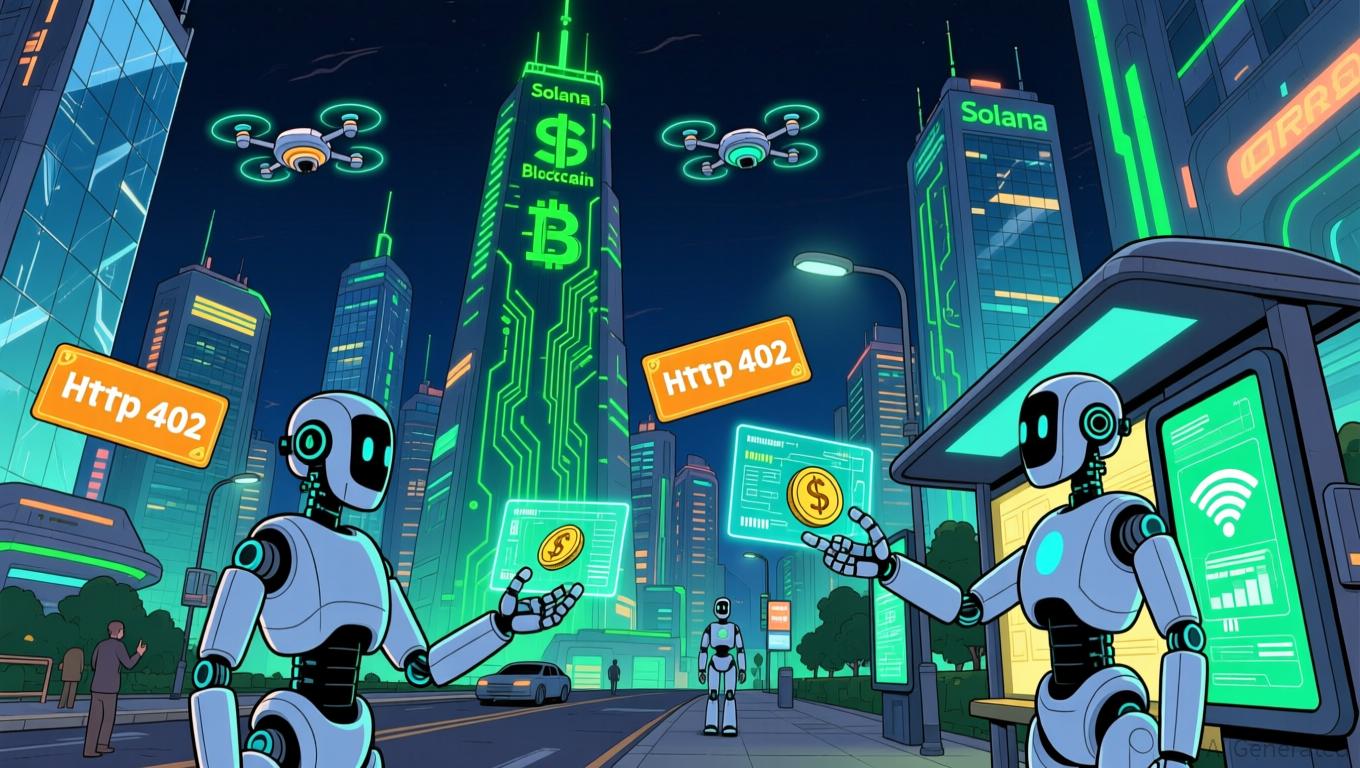
The landscape of x402 payments has undergone a dramatic transformation, with Solana overtaking its rivals to become the primary blockchain for HTTP 402-based transactions. On November 30, Solana achieved a milestone by reaching $380,000 in daily payment volume, representing an extraordinary 750% increase compared to the previous week. This rapid growth highlights Solana’s rising influence in the machine-to-machine (M2M) payments sector, where minimal transaction fees and high processing speeds are essential for enabling scalable microtransactions.
The x402 protocol is specifically designed to allow APIs and AI agents to settle stablecoin payments using HTTP 402 “Payment Required” codes. Unlike speculative trading, the current demand is being driven by bots and autonomous systems that require real-world utility, signaling a shift in how blockchain technology is being adopted.
Solana’s Competitive Edge Over Other Blockchains
Solana’s dominance in the x402 space sets it apart from other blockchains. While Ethereum depends on Layer 2 solutions to improve scalability, Solana’s core network is engineered for high-speed and efficient transactions, making it ideal for micropayments and AI-powered processes. The network’s ability to process transactions at extremely low costs, along with enhancements like the Firedancer upgrade, has attracted developers and partners such as Kalshi, which is moving prediction-market activities on-chain. In contrast, Ethereum’s ecosystem is fragmented, with liquidity distributed across platforms like Arbitrum, Optimism, and Base, making it challenging to match Solana’s streamlined economic model.
Transforming Web3 Monetization with x402
The adoption of the x402 protocol is revolutionizing how developers generate revenue from Web3 applications. Projects ranging from AI agent frameworks to privacy-focused extensions are utilizing x402 to implement pay-per-use systems, eliminating the need for subscriptions or API keys. According to industry research, this protocol is unlocking new revenue streams that were previously unattainable, as evidenced by the surge in on-chain activity throughout 2026. For Solana, this aligns with its broader goal to become the foundation of the agent economy, leveraging its speed and low costs to tap into the projected $20.2 billion in buy-now-pay-later (BNPL) spending during the holiday season.
Utility-Driven Growth Distinguishes Solana
What sets Solana’s x402 expansion apart is its foundation in genuine utility rather than speculative trends. Unlike the volatility seen with meme coin-driven surges, Solana’s transaction volume is largely attributed to recurring payments for services such as computing resources and data access, indicating a move toward sustainable demand. This stands in contrast to Ethereum, which relies more heavily on institutional investment and broader economic factors. While ETF inflows for Ethereum have stagnated, Solana has consistently attracted $476 million in inflows over a 19-day period, underscoring its growing appeal.
The Future of Blockchain Payments
As the x402 ecosystem continues to grow, Solana’s leadership is prompting new discussions about the direction of blockchain-based payments. Ethereum’s focus on decentralization through its modular roadmap contrasts with Solana’s approach of incentivizing network participation through validator rewards. These differing strategies represent two distinct visions for the industry’s future. Analysts believe that Solana’s continued success will depend on maintaining its momentum, especially as upcoming upgrades like Firedancer and Fusaka are expected to further enhance network performance. For now, the x402 standard has solidified Solana’s position as the preferred infrastructure for automated payments, potentially reshaping the flow of value in the digital economy.
Disclaimer: The content of this article solely reflects the author's opinion and does not represent the platform in any capacity. This article is not intended to serve as a reference for making investment decisions.
You may also like
XRP News Today: XRP Faces a Defining Moment in 2026—Will Institutional Excitement or Practical Use Prevail?
- Grayscale XRP Trust (GXRP) launches on NYSE, joining 3 XRP ETFs as institutional adoption accelerates post-SEC legal resolution. - Ripple's XRP gains traction in cross-border payments via partnerships with Santander , SBI, and Amex , competing with stablecoins/CBDCs. - XRP faces challenges: declining ledger transaction volume, banks favoring ODL corridors over direct XRP holdings, and stablecoin competition. - ETF allocations remain in cold storage, limiting on-chain demand, while 2026 price forecasts hi
Industrial Property Prospects in Webster, NY, During Xerox Campus Transformation: A Strategic Plan for Sustainable Value Growth via Infrastructure
- Webster , NY, is redeveloping the Xerox campus with a $9.8M FAST NY grant, transforming a 300-acre brownfield into a high-tech industrial hub. - Infrastructure upgrades, including roads and sewer systems, aim to attract $1B+ in private investment, exemplified by a $650M fairlife® dairy plant creating 250 jobs. - Parcel subdivision and municipal boundary adjustments eliminate jurisdictional barriers, enabling scalable development and attracting manufacturers requiring contiguous land. - Industrial vacancy

Bitcoin Updates: 2025 Crypto Downturn Driven by Liquidity, Not Crisis, as Markets Demonstrate Evolving Stability
- Cryptocurrency markets collapsed in late 2025, with Bitcoin dropping 31% as $1.2T in value vanished amid liquidity crunches and macroeconomic pressures. - Analysts attribute the selloff to thin trading during holidays, BoJ rate hike speculation, Chinese crackdowns, and Tether/MicroStrategy risks. - MicroStrategy's potential Bitcoin sales and Fed policy shifts highlight institutional influence over volatility, contrasting past retail-driven crashes. - Market maturity is tested as Bitcoin approaches $60K s
Dogecoin News Today: Dogecoin Faces a Turning Point: Popular Enthusiasm Meets Broader Economic and Regulatory Challenges
- Dogecoin (DOGE) drops 7% amid broader crypto bearishness, extending a five-day losing streak as retail-driven momentum falters. - Technical indicators signal weakness near $0.13000, with a break below $0.12986 risking a slide toward $0.09500 support. - Japan's new DOGE department, focused on fiscal efficiency, adds macroeconomic uncertainty, influencing investor trust in markets. - Diverging futures open interest (OI) highlights mixed sentiment: DOGE and SHIB attract optimism , while PEPE faces declining

Trending news
MoreCrypto prices
More





