
12 New Projects, a List of Privacy Projects Officially Recognized by Solana

What are some notable privacy projects in the Solana ecosystem?
Yesterday, Solana's official account posted a thread introducing 12 privacy-related projects in the ecosystem, covering categories such as encrypted computation, privacy infrastructure, payments and wallets, transactions, prediction markets, and smart protection.
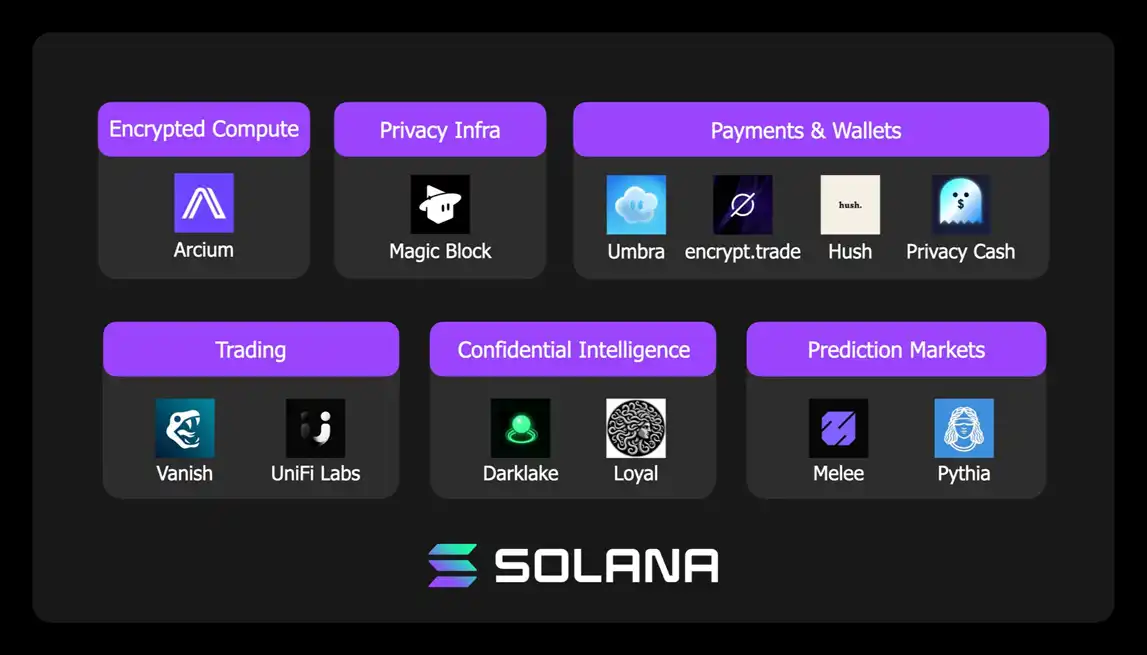
Encrypted Computation
Arcium
On March 27, the encrypted computation network Arcium announced the completion of its angel round funding, with investors from various fields, including some community fundraising through echo. The current total funding amount has reached $11 million. Jupiter Ventures Meow, MegaETH founding team member namik, Jupiter Ventures Siong, and others participated in the investment.
Arcium was originally a privacy protocol Elusiv on Solana, which later transformed into a more comprehensive privacy computing platform. Using MPC and ZKP technology, it allows computation on encrypted data without exposing the data content.
In the Arcium network, the Multi-Party Execution Environment (MXE) is responsible for securely executing computation tasks, and users can individually set the encryption protocols used for each MXE on-demand. arxOS is the distributed execution engine within the Arcium network, responsible for coordinating computations and supporting Arx nodes and clusters. Each node (similar to a core in a computer) provides computing resources to execute as defined by MXE
A notable highlight is that Arcium offers two different MPC protocol backend implementations, one called "Cerberus," which operates under the "dishonest majority" trust model, with cheating detection and identifiable abort mechanisms. This means that as long as one node is honest, privacy is ensured. The system can also identify dishonest nodes, kick them out, and impose penalties. This is in stark contrast to most protocols that require an "honest majority" (i.e., more than 51% of nodes are honest).
The other called "Manticore," designed specifically for AI scenarios. Although its security assumptions are not as strong as Cerberus, it is suitable for environments with access controls, such as AI training in a trusted environment.
Another privacy-related project on Solana, Umbra, achieves Solana on-chain private transfers through the Arcium network, which will also be introduced later in the text.
Despite releasing the tokenomics as early as March this year, Arcium has not yet conducted its TGE.
Privacy Infrastructure
MagicBlock
On April 25, the on-chain gaming engine MagicBlock completed a $7.5 million seed round, bringing the total funding to $10.5 million. This round was led by Faction, with participation from Maven11, Mechanism Capital, Robot Ventures, Delphi Ventures, Equilibrium, Pivot Global, as well as angel investors like Solana co-founder Toly, Helius Labs CEO Mert, and former Backpack co-founder Tristan Yver.
While initially focused on the on-chain gaming engine, in September this year, MagicBlock pivoted to a TEE-protected scaling solution called Ephemeral Rollup. In their own words, this is the first privacy infrastructure built on a Trusted Execution Environment (TEE) designed specifically for Solana's native support.
Traditional privacy solutions have required significant cryptographic overhead, slow execution speeds, and complex integration processes. MagicBlock took a pragmatic approach: real-time Ephemeral Rollup aggregates run standard Solana transactions within an Intel TDX secure enclave, creating a hardware-validated "black box" where sensitive computations are protected. It is not only auditable but also deployable with just a few lines of code, suitable for building confidential order books, dark pools, DeFi protocols with regulatory compliance and built-in privacy controls, secure auditable payment channels, as well as consumer-grade applications and games that require privacy protection.
Overall, this is an infrastructure designed to enable on-chain privacy features and applications, known for its speed, developer-friendly Solana integration, and high degrees of access control. However, from this perspective, being infrastructure that is almost unrelated to retail investors, it is difficult to say whether they will issue tokens in the future.
Payments & Wallets
Umbra
As mentioned earlier, the project achieves Solana on-chain private transfers through the Arcium network. Umbra can obscure on-chain fund flows and provides a voluntary audit feature, allowing users to disclose their transaction history to third parties for compliance or auditing purposes.
The foundation of Umbra's anonymity layer is the "Shielding Pool," which is a smart contract holding a large amount of mixed tokens from various users. A Shielding Pool functions like a public vault where everyone deposits tokens. Once tokens enter the vault and mix with tokens from everyone else, it is computationally infeasible to determine the specific token ownership. With more users and assets flowing into the pool, each user's privacy is further enhanced.
A depositor places their tokens into the Shielding Pool, and the protocol captures the deposit details (such as amount and the recipient's Umbra address) and encrypts it. On-chain, you can only see that the deposit came from a Solana address, but you cannot see where the deposit ultimately went.
A recipient generates a zero-knowledge proof, which is validated by the Umbra contract, and the contract transfers the funds to the recipient's Umbra address. During the asset withdrawal process, the required Gas fee is deducted directly from the received amount, eliminating the need for the recipient's Umbra address to have SOL balance to complete the withdrawal, ensuring the entire process is fully private.
encrypt.trade
Privacy DeFi on Solana, supporting private transfers and swaps. A Colosseum Hackathon-winning project supported by the Alliance.
When a user performs a swap on this platform, they are first required to wrap the tokens. The tokens are encrypted via the ElGamal algorithm during the wrapping process. On-chain, only the token type post-wrap is visible, while the actual encrypted data is stored off-chain.
In other words, the wrapped tokens serve as a "pointer" on-chain, allowing on-chain applications (such as Jupiter) to identify the token. The specific transaction amount and direction are computed in a Trusted Execution Environment (TEE) secure environment. After computation, the data is re-encrypted and the on-chain data is updated, executing the corresponding actions using the algorithm of the associated on-chain application.
The outcome is that through encrypt.trade's swap process, unlike traditional DEXs, transaction data is not explicitly broadcasted on-chain. Only the status change of the wrapped assets is visible on-chain, without revealing transaction amounts, counterparties, or even whether the transaction actually occurred.
Hush
The product has not been officially launched yet. According to its official Twitter description, this is a privacy-first Solana wallet that will provide SOL obfuscation, one-time addresses, and privacy transaction features. Additionally, it also supports wallet creation for dApps and has a built-in ZEC bridge.
Privacy Cash
The current version's functionality is relatively simple, only supporting private SOL transfers. In the future, it will be updated to support private transfers and swaps for SPL tokens.
The sender will deposit SOL into a privacy pool, which will generate a "credential" added to a Merkle Tree. The recipient, through zero-knowledge proof validation, can withdraw the corresponding funds to any receiving address.
Transaction
Vanish
Another Colosseum hackathon winning project, which also received a $1 million pre-seed investment from Colosseum, Solana Ventures, and Pivot Global.
Vanish uses smart transaction routing technology to maintain transaction privacy through secure liquidity sources. The documentation lacks many technical details, with the project emphasizing compliance privacy and reassuring users about anti-money laundering concerns.
UniFi Labs
The product has not been released yet and is focused on perpetual privacy contracts.
Smart Protection
Darklake
This project aims to do many things, describing itself as a "zero-knowledge proof privacy layer." However, they do not intend to create a comprehensive privacy system or chain but instead utilize zero-knowledge proofs to directly build practical privacy applications on Solana.
What is currently live is the "blind liquidity pool," also referred to as zk-AMM. The blind liquidity pool adds an encrypted commitment layer to automated market makers (AMMs), making slippage data invisible to observers but verifiable post-transaction. The principle is that after a user submits a swap transaction, the system will generate a hash and a unique encrypted value based on the transaction and submit both with the transaction information. Darklake's proof generator will produce a Groth16 proof to demonstrate that the calculated result is within or exceeds the slippage range. If the proof is valid, the transaction settles; otherwise, it is reversed, and the funds are returned.
They also plan to create a privacy version of a perpetual contract and token issuance. As for why Solana classifies this project as smart protection, I think one reason is that they are doing everything, and another reason is that they have also integrated Arcium's technology stack to handle multi-party privacy state coordination after transaction completion.
Loyal
Loyal is an open-source, decentralized, censorship-resistant, and auditable smart protocol supported by MagicBlock and Arcium. The simplest summary of this project is that they aim to create an on-chain AI that safeguards user data privacy, starting from transactions related to encryption and gradually evolving to assist with daily life and work transactions like AI currently available in the market.
Prediction Market
Melee and Pythia
Both have utilized Arcium's technology. Overall, there isn't much to delve into at the technical level; both have added a layer of privacy to the order book of the prediction market, achieving the effect of a prediction market dark pool. Whether this will be what players need after the prediction market develops to a certain extent remains to be seen over time.
Disclaimer: The content of this article solely reflects the author's opinion and does not represent the platform in any capacity. This article is not intended to serve as a reference for making investment decisions.
You may also like
Strategy's stock trading volume has now surpassed that of financial giant JPMorgan Chase.
Wall Street Journal: Investors are worried about a new crypto winter.
Trending news
MoreCrypto prices
More





