
Ethereum Updates: Developers Rethink L2 Solutions as Ethereum's Mainnet Sees "Extremely Low" Transaction Fees
- Vitalik Buterin claims Ethereum’s L1 is now cheap and efficient enough, reducing reliance on L2 solutions in 2025. - Upgrades like EIP-4844 and PoS have slashed fees, with gas costs at "dirt cheap" levels and gas limits rising. - The upcoming Fusaka upgrade (Dec 3) aims to boost scalability, while ETF inflows and $260M tokenized assets signal growing institutional interest. - Critics question Ethereum’s value capture in an L2-dominated ecosystem, but Buterin emphasizes L1’s security and cost-effectivenes
Vitalik Buterin: Layer 2 No Longer Essential for Ethereum Developers in 2025
Vitalik Buterin, one of Ethereum’s founders, has recently stated that developers may no longer need to focus on Layer 2 (L2) solutions in 2025. According to Buterin’s announcement on X (formerly Twitter) on December 1, 2025, Ethereum’s main network (Layer 1, or L1) has become sufficiently affordable and efficient for direct development, challenging the widespread practice of moving to L2 networks for better scalability and lower costs.
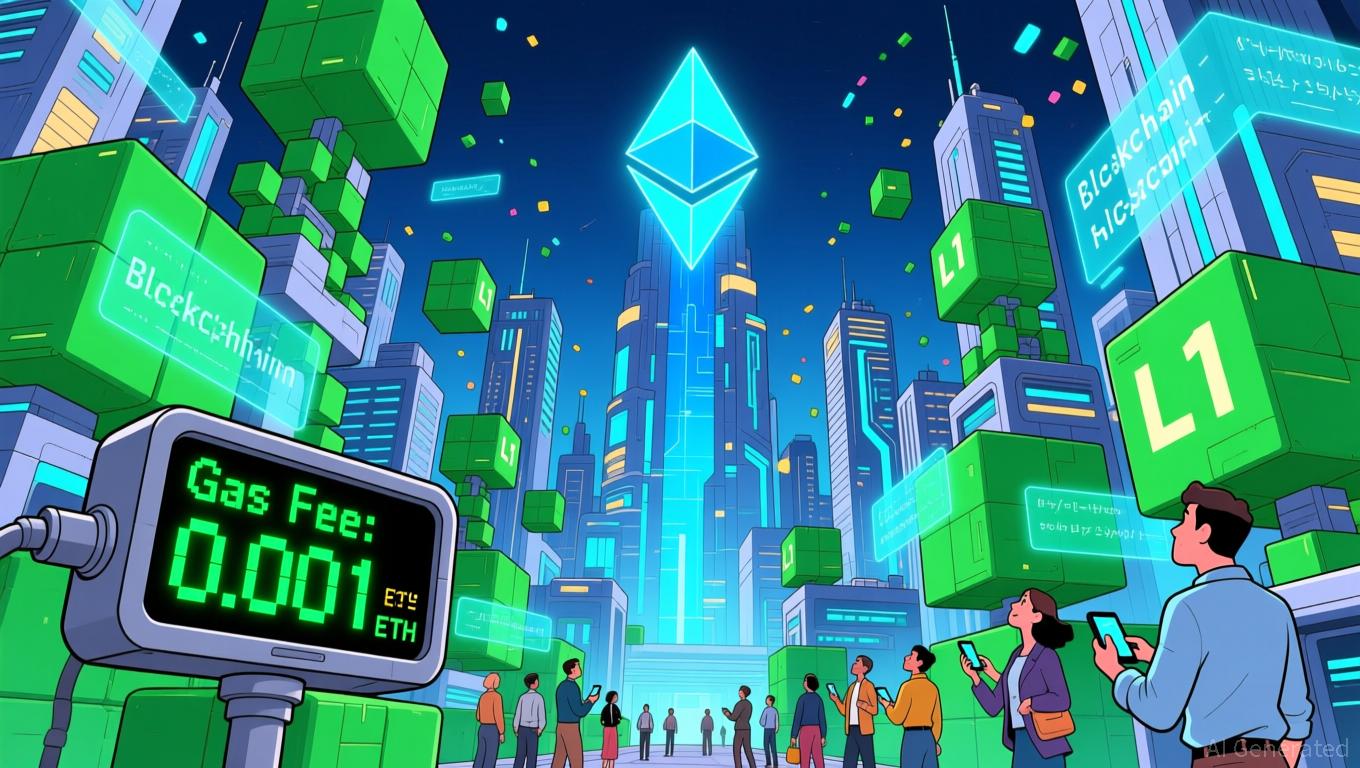
This perspective marks a significant turning point for Ethereum. Thanks to a series of network upgrades and technical improvements, transaction fees have dropped dramatically, making on-chain operations much more accessible. Key advancements include the rollout of EIP-4844 (proto-danksharding), which significantly reduced data expenses for rollups, and the shift to Proof-of-Stake (PoS), which improved scalability and cut energy use. Further enhancements in client software and storage technology—such as more affordable hard drives—have enabled a higher gas limit, pushing transaction costs even lower.
As a result, Ethereum’s transaction fees are now at record lows, making the network far more attractive for developers and users alike.
Impact on the Ethereum Ecosystem
The implications for the broader Ethereum ecosystem are significant. While L2 platforms like Arbitrum and Optimism have become popular for their ability to offer cheaper and faster transactions, Buterin’s comments suggest that the line between L1 and L2 is becoming less distinct. Developers now have a pivotal decision to make: whether to build directly on Ethereum’s mainnet, which is now both cost-effective and secure, or to continue utilizing L2 solutions for specialized needs. This evolution could encourage more projects to choose the simplicity and security of L1, rather than dealing with the added complexity of L2 infrastructures.
Upcoming Fusaka Upgrade
Ethereum’s forthcoming Fusaka upgrade, scheduled for December 3, 2025, is expected to further boost the network’s scalability and security. This upgrade, which merges the Fulu and Osaka hard forks, is designed to help Ethereum handle increased transaction volumes from L2 chains while also improving the efficiency of both the consensus and execution layers. Industry analysts view Fusaka as a major step forward, strengthening Ethereum’s role as a leading platform for decentralized applications.
Market Trends and Institutional Interest
Market dynamics are also favoring Ethereum’s renewed momentum. Both spot and Ether ETFs have experienced a reversal in investor sentiment, with net inflows of $70 million and $312.6 million, respectively, after a month of outflows. Additionally, Ethereum-based tokenized assets, such as Fidelity’s FDIT, have reached a market capitalization of $260 million, highlighting growing institutional interest in tokenized real-world assets and stablecoins.
Ongoing Debate: L1 vs. L2 Value
Despite these advances, questions remain about how Ethereum can capture value in a landscape increasingly dominated by L2 solutions. While L2s provide lower fees and greater throughput, some critics wonder how Ethereum will benefit from activity that occurs off-chain. Buterin’s renewed focus on L1 development suggests that Ethereum’s core strengths—security and decentralization—could become even more important as the main network becomes more affordable.
Looking Ahead
As 2025 unfolds, Ethereum’s challenge will be to maintain a balance between scalability and security. With the Fusaka upgrade approaching and mainnet fees at historic lows, Ethereum is positioning itself as a flexible platform capable of supporting both traditional on-chain operations and innovative L2 solutions. For developers, the message is clear: Ethereum’s mainnet is now a practical and powerful foundation for the next generation of blockchain projects.
Disclaimer: The content of this article solely reflects the author's opinion and does not represent the platform in any capacity. This article is not intended to serve as a reference for making investment decisions.
You may also like
Chainlink ETF Set to Debut as LINK Slips Amid Market Weakness
Striking baristas win $38.9 million in compensation, yet contract disputes continue
- Starbucks settles NYC Fair Workweek Law violations for $38.9M, including $35.5M restitution to 15,000+ workers. - Striking baristas demand collective bargaining amid ongoing labor disputes and unionization efforts at 550 stores. - Mayor-elect Mamdani and Sen. Sanders join protests, framing demands as moral issues against corporate resistance. - Settlement addresses 500,000 scheduling violations since 2021, with workers receiving $50/week compensation. - Starbucks defends labor law complexity but faces cr

Alphabet's AI-driven ecosystem accelerates flywheel momentum, driving shares up by 68% in 2025
- Alphabet's stock surged 68% in 2025, outperforming peers like Microsoft and Nvidia , driven by strong AI monetization and cloud growth. - Analysts raised price targets to $375-$335, citing Google Cloud's $15.2B Q3 revenue (34% YoY) and $155B cloud backlog growth. - The company's AI ecosystem spans Search, YouTube, and Workspace, generating premium subscriptions and ad yield through Gemini's 650M MAUs. - Projected cloud revenue could exceed estimates by $40B, but risks include regulatory scrutiny and comp

XRP News Today: Vanguard Changes Position on Crypto ETFs, Pointing to Market Maturity and Increased Demand
- Vanguard Group will enable crypto ETF trading on its platform from December 2, 2025, reversing years of opposition to digital assets. - The firm supports Bitcoin , Ethereum , XRP , and Solana ETFs but excludes memecoins, treating crypto as non-core assets like gold . - Market maturation, $25B+ ETF inflows, and regulatory compliance drive the shift, positioning Vanguard as the last major U.S. broker to adopt crypto ETFs. - The move reflects growing institutional confidence in regulated crypto structures a
Trending news
MoreCrypto prices
More





